Rechercher dans ce blog

Monday, May 31, 2021

More than 800 residential school students died in Alberta — advocates say it's time to find their graves - CBC.ca

WARNING: This story contains details some readers may find distressing.


When Jackie Bromley heard that the remains of 215 children were found at the site of a former residential school in B.C., she had flashbacks to her time at St. Mary's Residential School on the Blood Reserve in southern Alberta. 

Bromley, who is now 70, remembers students talking about graves behind the school when she was 10 — but doesn't remember seeing any headstones.

"I thought about the backyard, apparently there were some graves there. And the first thing I thought of was, I wonder if there are some kids that were buried, you know?"

Bromley's classmates were right — there were students' graves in the schoolyard. A letter in 1945 from an Indian agent to the school's principal requests that Indigenous workers be made to redig the graves next to the school, to make them even deeper.

The Truth and Reconciliation Commission (TRC) states that it's difficult to place an exact figure on how many residential schools operated in Canada. 

Kisha Supernant says it's similarly hard to say just how many unmarked children's graves there are. 

Students write on a chalkboard at Red Deer Indian Industrial School in Alberta in either 1914 or 1919. The school had one of the highest mortality rates, with at least 70 of roughly 350 students dying during the 26 years it was in operation. It is estimated 50 children may be buried in an unmarked cemetery in a field nearby. (United Church of Canada, Archives)

Supernant, who is Métis and a descendant of the Papaschase First Nation, is an anthropology professor at the University of Alberta in Edmonton. She and her team use ground-penetrating radar equipment to help Indigenous communities survey burial grounds across the Prairies.

She said remote sensing techniques such as GPR and drones are crucial in surveying unmarked graves to ensure the sites are not physically disturbed. 

"There is power in the scientific evidence we can provide. It shouldn't be necessary, communities should be able to be listened to, but I am happy to support communities in that," Supernant said. 

"The ownership and access to all the data sits with the community…. This is not showing up and running a piece of equipment…. It's a process of engaging with the community, with being attentive to the sensitivity of what we're doing and the potential impacts it can have."

At least 4,100 children died

Supernant as well as Indigenous leaders and advocates are calling on the federal government to fund the use of GPR equipment at former residential school sites across the country.

"This is part of reconciliation. This is part of the calls to action and I strongly believe that communities should be resourced to do the work that they need and want to do," she said. 

The Indian Residential School Settlement Agreement has identified 139 residential schools across Canada — 25 of which were in Alberta. However, that number excludes schools that operated without federal support, such as those run by religious orders or provincial governments. Some schools also underwent name changes, or were relocated.

Click here to see a larger version of the map of residential school locations.

More than 150,000 First Nations, Métis and Inuit children were placed in such schools between the 1870s and 1990s.

At least 4,100 children died while attending school — more than one in 50 students — and the TRC estimates the actual toll could be 6,000 or higher. At least 821 of those deaths were in Alberta.

Linda Many Guns, the associate vice-president of Indigenization and decolonization at Mount Royal University, is descended from residential school survivors. She said research shows many parents were never told what happened to their children — and extensive research will be required to uncover many students' stories.

"There was an extensive pattern of genocide that was deliberately being instituted, not just through these organizations, but also, on a daily basis, through the Indian agents that were overseeing and administering all the reserves," she said.

'Ancestors are asking me to do this work'

A TRC report stated that Indian Affairs was generally opposed to sending the bodies of children who died at school back home, because of the cost. It's estimated that many residential schools have burial sites due to the high death rates — but few have locations that are formally documented, and even fewer are maintained. 

The graves found in Kamloops are believed to represent previously unrecorded deaths. 

WATCH | Remains of 215 children found on grounds of B.C. residential school:

A B.C. First Nation believes it has found the remains of over 200 Indigenous children at the former site of the Kamloops Indian Residential School. It housed hundreds of Indigenous children over eight decades. 2:12

"These schools were established to forcibly assimilate Indigenous children into Euro-Canadian culture. Underfunded, located in remote places far away from children's home communities, and lacking proper oversight, the schools were plagued by disease, dubious educational outcomes and physical, emotional and sexual abuse," reads an Alberta government resource guide on the schools' history.

For Supernant, the history is personal. She said through her research, she's learned of relatives who attended residential schools.

"I feel quite strongly that the ancestors are asking me to do this work," she said. "It's the most meaningful and important work I will ever do."

The TRC report called on the federal government to create an online registry of residential school burials, and to work with impacted groups to develop a plan for the ongoing identification, documentation, maintenance and commemoration of burial sites.

Funding denied

The TRC did request $1.5 million in funding to search for those unmarked graves in 2009, but that funding was denied by Ottawa.

Chantal Chagnon drums at a vigil in Calgary for the children of Kamloops Indian Residential School on Tk’emlups te Secwépemc First Nation. Shoes representing the bodies of 215 children found buried at the former school site this week were laid on the steps of city hall. (Terri Trembath/CBC)

"Subjected to institutionalized child neglect in life, they have been dishonoured in death," the report reads.

Kelly McGillis organized a vigil in Calgary over the weekend to honour the children in B.C. and call for action to search for other grave sites.

"We need Canada and everyone to acknowledge that if 215 children have had their lives lost and we have 139 residential schools and all across Canada … where are our leaders in finding out where our ancestors are buried and how we can honour them?"

At the vigil, 215 shoes were set out to represent each child. The City of Calgary has ordered flags to be flown at half-mast. 

Bromley, whose parents and grandparents also attended residential school, said being able to honour the lost children would be healing.

"Yeah, I would rather like to know the list [of names]. A proper list."


Support is available for anyone affected by the lingering effects of residential schools, and those who are triggered by the latest reports.

The Indian Residential School Survivors Society (IRSSS) can be contacted toll-free at 1-800-721-0066.

A national Indian Residential School Crisis Line has been set up to provide support for former students and those affected. People can access emotional and crisis referral services by calling the 24-hour national crisis line: 1-866-925-4419.

Adblock test (Why?)


More than 800 residential school students died in Alberta — advocates say it's time to find their graves - CBC.ca
Read More

More charges coming as Aylmer church continues to defy provincial rules - Global News

Aylmer Police say charges are pending after yet another large gathering at the Church of God Restoration on Sunday.

Officers were at the church at 751 John St. on Sunday and say they counted more than 283 people attending a large gathering at the church. Police say an outdoor stage and seating area was set up for the service.

Police say they are reviewing the available footage, and charges against the church and those identified as participants are pending.

It’s the third consecutive Sunday the church has held a service since a judge ordered the doors locked at the church earlier this month.

Police previously charged a 37-year-old man and a 57-year-old man in relation to a large gathering at the church last Sunday.

Advertisement

© 2021 Global News, a division of Corus Entertainment Inc.

Adblock test (Why?)


More charges coming as Aylmer church continues to defy provincial rules - Global News
Read More

Home inspectors say buyers are 'in trouble' in hot housing market with inspections on the decline - CBC.ca

Home inspectors in Ontario are sounding the alarm.

Some say that in today's hot real estate market, more and more buyers are being pressured to make offers on homes without full home inspections.

"It's like playing Russian Roulette with your finances and your home's finances and your family's finances," said Len Inkster, the executive secretary of the Ontario Association of Certified Home Inspectors, one of a number of groups representing workers in the field.

He said that based on conversations he's having with inspectors throughout the province, he believes that less than 25 per cent of all home sales are being inspected.

"In this current situation, Ontario buyers are in trouble"​​ - Bob Price, Home inspector

"It's so out of control," said Bob Price, a home inspector for Windsor, with 15 years in the industry.

"Home buyers, I think, that they now realize they're making the biggest purchase of their lives, but they have no protection."

He explained that in today's "frenzied market," buyers have a better chance of getting a house without any conditions, including getting an inspection, adding that the pressure of the market and the rush to make a purchase are forcing people to make poor decisions.

Inspectors warning against limited-scope inspections

Matt Awram, owner of Third Eye Home Inspections in Amherstburg, worries that people are being misinformed. 

"They're being told that they can't have a home inspection, or they're not going to get the house, but that's just not the case," he said.

Len Inkster, the Executive Secretary of the Ontario Association of Certified Home Inspectors, says he's been fighting to regulate the industry for nearly nine years. (CBC)

He frequently gets calls from recent home buyers, he explained, requesting an inspection after a sale has gone through because they weren't able to get one beforehand, sometimes leading to "horror stories."

He explained that while pre-purchase inspections (after an offer has been accepted) are rare now, pre-offer and pre-listing inspections continue to take place, but he stresses that buyers should make sure they're getting full inspections, instead of what are called "limited-scope inspections." These inspections only focus on certain areas of a home rather than doing a complete inspection.

Some, like Awram and Price, won't do limited-scope inspections. Inkster says they're growing in popularity in some parts of Ontario, especially in Windsor-Essex and Chatham-Kent, adding that he's also seen them popping up in Peterborough and Kingston.

"Hate them," Inkster said, stressing that his association is firmly against them. 

"The problem with the limited-scope inspections, if you do it for a buyer, it's not extensive enough to give the buyer the right information on the condition of the property to let them understand what sort of maintenance costs they might be letting themselves in for."

Inkster says they're frequently used as a marketing tactic by realtors representing sellers, during the pre-listing phase. He said it might encourage buyers to not get their own inspections. 

Time limits for inspections

Damon Winney, the president of the Windsor-Essex County Association of Realtors, says buyers should always aim to get a full home inspection whenever possible. 

However, given that homes are selling quite quickly, "you may be under a time crunch," he explained.

Matthew Awram, of Third Eye Home Inspections, says he's calling for legislation to regulate the industry. (Katerina Georgieva/CBC)

"I think it's dangerous to limit the scope of an inspection. It should be as much as you can do within the property itself," but adds that in cases where time doesn't allow for a full inspection, he says "a limited scope is better than nothing."

Sellers also dictate whether or not a home inspection can even happen, Winney explained. 

"Some sellers may say, 'No, we're not going to allow a home inspection,' which may raise a question mark on the property. Number two, is we may only have a limited time frame that we're able to conduct the inspection with the inspector with us."

Price explained that often, he'll get told he only has a 30-minute window to do a full inspection, even though a full inspection takes an hour and 20 minutes to do. In those cases, he turns around and walks out because he can't do his job in that amount of time. 

"It's nothing that we've ever seen in the past," he said. 

"In this current situation, Ontario buyers are in trouble."

Damon Winney says his advice to buyers is to always aim to get a full inspection on a house before making an offer. (CBC)

Winney said buyers paired with a strong realtor can sometimes try to negotiate more time for full inspections.

But Inkster blames realtors for creating the time crunch in the first place. 

He says the current market is being driven by "auction fever" with buyers and sellers making decisions born out of panic. 

"There's a whole series of things going on and it's being driven by stupidity and greed, in my opinion," Inkster said. 

"Every single professional dealing in real estate has got something to answer for there. But above that, the government is just — and it doesn't matter which colour you you vote for — they're all the same. Nobody seems to want to do anything except make a profit."

Fighting for regulation of the industry

Awram, Price and Inkster are all pushing for regulation of the inspection industry. 

Bob Price says his business has taken a big hit. (Submitted by Bob Price)

Lack of regulation has been an issue for years, Inkster said, only made worse by the market. He said his association has been pushing for legislation for nearly nine years.

"It will actually allow us to weed out the bad inspectors. It will stop people who are not qualified and therefore not licensed from doing inspections at all," Inkster said. 

The Ministry of Government and Consumer Services says the Home Inspection Act is not yet in force.

In a statement to CBC, a spokesperson said, "The ministry is continuing to review this file to determine the best approach to protecting the interests of home buyers and sellers in an appropriate and effective way."

'Industry is bleeding'

In the meantime, Inkster says the industry is on a steep decline, with many inspectors leaving the industry altogether. 

He said they've lost around 65 per cent of professional inspectors in Ontario since 2019.  He worries that if things carry on this way, in another 18 months, there won't be any home inspectors in Canada.

"This industry is bleeding," Inkster said.

Price says his business is way down. He used to do 750 inspections a year, but that he's now down to about 150.

"It's a catastrophic hit, there's no doubt," Price said.

He's frustrated that nobody is stepping up to the plate to fix the situation to ensure consumers are being protected.

"I've never seen anything fail as much as the home inspection industry," Price said. 

Adblock test (Why?)


Home inspectors say buyers are 'in trouble' in hot housing market with inspections on the decline - CBC.ca
Read More

Toronto Maple Leafs need more from core - TSN

Columnist image

It’s starting to look gloomy in Toronto.

The Maple Leafs let a commanding series lead against an inferior opponent slip away over the weekend, and now find themselves in a tenuous spot. Montreal deserves endless credit for how they have been able to skate with Toronto in the series, ensuring all of the pressure heading into Game 7 will lay at the feet of Sheldon Keefe’s club.

The Maple Leafs have been here before – many times, in fact. That’s where some of the frustration from the fan base is boiling over. Five years ago, when the Maple Leafs were a fun and upstart team heading into David-versus-Goliath-type battles against the Boston Bruins, a tough opening-round loss would have been digestible. Here? Not so much.

In one breath, it’s hard to be too critical of the Maple Leafs this series. Over the first six games, Toronto has 52 per cent of the shots, 60 per cent of the expected goals, and have outscored the Canadiens 17 to 11. If you play that way over an extended period of time, you are going to win more often than not.

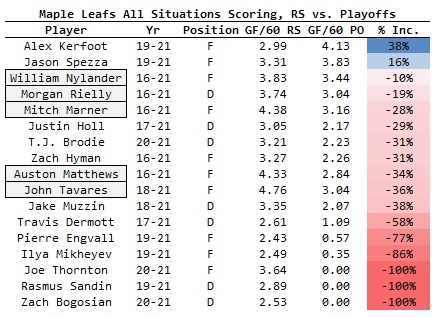
But former Florida Panthers scout Rhys Jessop pointed out something that’s impossible to ignore after Saturday night, and that’s the reality of what’s happening at the top of the Maple Leafs lineup. The team’s core forwards may be as dangerous as ever, but time and time again we’ve seen this group score considerably less in the playoffs than in the regular season.

It’s a huge concern because the Maple Leafs can’t rest their laurels on firm defensive play or indomitable goaltending over lengthy stretches. This team is built to outscore you, and they are good at doing that. But when the scoring isn’t there, the team is beatable.

It is true that scoring the playoffs, in relative terms, is quite difficult. Over the past five seasons, scoring has dropped in the postseason by about 7 per cent, some of that contributable to a reduction in power-play opportunities. But we are seeing much more than a 7 per cent drop-off here:

Embedded Image

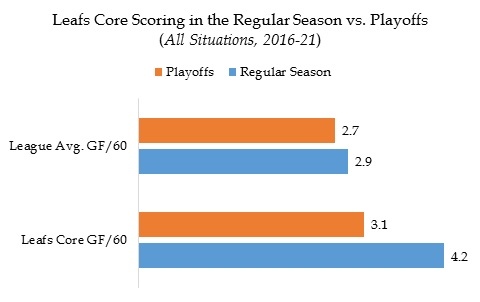
This trend is also true if you subset the data to just even-strength play. And that’s the problem here. The Leafs’ core is scoring three goals per 60 minutes of play in the playoffs, and if you just stared at that number long enough you could convince yourself that should be enough to get the job done.

But compare the Maple Leafs core in the regular season versus league averages to the playoffs versus league averages:

Embedded Image

In both instances I can show that Toronto’s core is above average at generating goals. But this team is reliant on those players generating goals at a considerably higher rate than their peers. In the regular season, Toronto’s top-end scorers are 30 per cent deviant from league-average scoring; in the playoffs, that number drops to 12 per cent.

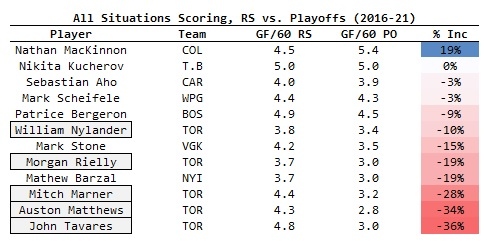
And though scoring in the postseason is certainly more difficult, we do not see this trend apply elsewhere. Let’s look at that same group of Maple Leafs skaters and compare them with some of the big names remaining in the playoffs, still analyzing that five-year horizon.

We see slowdowns in rate scoring, but look which group takes the biggest hit, and look which group’s playoff scoring is close to league average:

Embedded Image

Players like Patrice Bergeron and Mark Stone see less offensive production, but they are also the two best defensive forwards in the game. Other players, like Nathan MacKinnon and Nikita Kucherov, have been more dangerous offensively in the playoffs, which is saying something. But all of these forwards are still scoring at high rates and are still creating net-goal advantages for their respective franchises. Toronto’s core is too, but at a substantially smaller rate.

Toronto’s core players are not playing poorly. But they are paid to steamroll teams. That’s their competitive advantage. Whenever their scoring peters out, the team looks a lot more mortal. That’s why we keep scratching our heads watching the Maple Leafs in the playoffs. They have always been good. But can they be good enough?

We are going to find out Monday night.

Adblock test (Why?)


Toronto Maple Leafs need more from core - TSN
Read More

Sunday, May 30, 2021

Manitoba transferring more COVID-19 patients out of province after setting ICU admission record - CTV News Winnipeg

WINNIPEG -- More Manitobans in need of critical care have been transferred out of the province as Manitoba sees a record number of ICU admission in a 24-hour period.

According to Shared Health, over a 24-hour period, 17 COVID-19 patients were admitted to Manitoba ICUs.

Shared Health said the number represents nearly a quarter of Manitoba’s pre-COVID ICU capacity and does not include patients in need of ICU care for non-COVID health conditions.

"Manitoba’s ICUs continue to see admissions well above anything experienced in Wave Two of the pandemic and far exceeding pre-pandemic norms," said a Shared Health spokesperson in an email to CTV News.

Shared Health claims the number of COVID-19 patients admitted to Manitoba ICUs is on pace to be more than five times greater in May than the previous month.

As of midday Saturday, the health-care provider said 225 COVID patients had been admitted to ICUs in Manitoba so far in May. By comparison, 50 had been admitted for the entire month of April.

Shared Health said 123 patients are currently in the ICU, including 74 patients who have or are recovering from COVID-19. Fourteen of these 74 patients are under the age of 40.

According to Shared Health, the normal, pre-COVID baseline capacity for ICU was 72 patients.

"The impact of COVID-19 on patients who become ill with the virus are evident. However, there are also thousands of non-COVID patients negatively impacted by the unprecedented demands of the pandemic on our health-care system," said the Shared Health spokesperson.

SENDING MORE PATIENTS OUT OF PROVINCE

Four more COVID-19 patients in critical care were transported to Ontario on Saturday to help manage the ongoing surge in patient demand.

Shared Heath said the patients were sent to hospitals in Ottawa, Owen Sound, Markham and Sault Ste. Marie.

There are now 32 Manitobans being treated for the virus outside the province. One patient is getting care in Saskatchewan; the other 31 are all in Ontario.

In total, 35 patients have been transported out of Manitoba since May 18, with three being discharged back to the province.

Shared Health tells CTV News additional COVID-19 patients in ICU are tentatively scheduled for transfer on Sunday.

Adblock test (Why?)


Manitoba transferring more COVID-19 patients out of province after setting ICU admission record - CTV News Winnipeg
Read More

Manitoba ICUs grapple with staggering amount of COVID-19 admissions, more patients sent to Ontario - Global News

Shared Health says 225 patients have been admitted to Manitoba ICUs in May, blowing past the 50 admitted in April.

That includes 17 in only a 24-hour period; a quarter of the overall capacity and not including those admitted for non-COVID-19 issues.

“Manitoba’s ICUs continue to see admissions well above anything experienced in Wave Two of the pandemic and far exceeding pre-pandemic norms,” a Shared Health spokesperson wrote in an email statement.

“It is also an unfortunate milestone in the province’s pandemic response, representing the highest number of admission to ICU in a 24-hour period.”

As of Sunday morning, Shared Health says 123 patients were receiving critical care in Manitoba.

74 of those have or are recovering from COVID-19. Fourteen are under age 40.

Story continues below advertisement

Read more: Manitoba to get federal aid to battle COVID-19 surge as other provinces see success

Additionally, four more patients were transferred to Ontario on Saturday to cope with the ongoing surge, bringing the total to date to 34. Another person was previously sent to Saskatchewan.

The latest were sent to Ottawa, Owen Sound, Markham and Sault Ste. Marie.

Three people have since returned to Manitoba from Ontario, but are still receiving care in hospitals.

Shared Health says more transfers were tentatively scheduled for Sunday.

“We send our support and appreciation to families of patients and those on the front lines of our health care system as we hear about more Manitobans in ICU and more deaths,” Manitoba NDP leader Wab Kinew said in an email statement.

“Today, the Premier must increase the request of critical care nurses and respiratory therapists sent to our province from the federal government so that Manitobans in ICU can receive quality care in their home province.”

The premier’s request for dozens of health care staff, respiratory therapists, and armed forces support was answered by the federal government last week.

Read more: Medically equipped Hercules plane to transport Manitoba ICU patients to other provinces

Story continues below advertisement

Canadian Armed Forces members began arriving in the province on Friday.

“The impact of COVID-19 on patients who become ill with the virus are evident. However, there are also thousands of non-COVID patients negatively impacted by the unprecedented demands of the pandemic on our health-care system,” the Shared Health email reads.

“For all those reasons, it is critical that Manitobans follow public health measures and stay home as much as possible, regardless of whether they have been vaccinated.”

Click to play video: 'Operation LASER plane to help transport Manitoba ICU patients' Operation LASER plane to help transport Manitoba ICU patients
Operation LASER plane to help transport Manitoba ICU patients

© 2021 Global News, a division of Corus Entertainment Inc.

Adblock test (Why?)


Manitoba ICUs grapple with staggering amount of COVID-19 admissions, more patients sent to Ontario - Global News
Read More

BEYOND LOCAL: Here's why female robots are seen as being 'more human' than male ones - BradfordToday

This article, written by Sylvie Borau, TBS Business School, originally appeared on The Conversation and has been republished here with permission:

With the proliferation of female robots such as Sophia and the popularity of female virtual assistants such as Siri (Apple), Alexa (Amazon) and Cortana (Microsoft), artificial intelligence seems to have a gender issue.

This gender imbalance in AI is a pervasive trend that has drawn sharp criticism in the media (even Unesco warned against the dangers of this practice) because it could reinforce stereotypes about women being objects.

But why is femininity injected in artificial intelligent objects? If we want to curb the massive use of female gendering in AI, we need to better understand the deep roots of this phenomenon.

Making the inhuman more human

In an article published in the journal Psychology & Marketing, we argue that research on what makes people human can provide a new perspective into why feminization is systematically used in AI. We suggest that if women tend to be more objectified in AI than men, it is not just because they are perceived as the perfect assistant, but also because people attribute more humanness to women (versus men) in the first place.

Why? Because women are perceived as warmer and more likely to experience emotions than men, female gendering of AI objects contributes to humanizing them. Warmth and experience (but not competence) are indeed seen as fundamental qualities to be a full human but are lacking in machines.

Drawing on theories from dehumanization and objectification, we show across five studies with a total sample of more than 3,000 participants that:

  • Women are perceived as more human than men, overall and compared to non-human entities (animals and machines).

  • Female bots are endowed with more positive human qualities than male bots, and they are perceived as more human than male bots, compared to both animals and machines.

  • The inferred humanness of female bots increases perceived uniqueness of treatment from them in a health context, leading to more favorable attitudes toward AI solutions.

We used several different measures of perceived humanness, compared to both animals and machines. For example, to measure blatant humanness of female and male bots compared to animals, we used the ascent humanization scale based on the classic “march of progress” illustration. We explicitly asked online respondents to indicate how “evolved” they perceived female or male bots to be, using a continuous progression from ancient apes to modern humans.

To measure the blatant perceived humanness of female and male bots compared to machines, we created a scale that measures blatant mechanistic (de)humanization, by picturing man’s evolution from robot to human (instead of ape to human). Of course, we created both a female and a male version of each of these scales.

Other measures captured more subtle and implicit perceptions of humanness, by asking respondents the level of emotions they attributed to male and female bots. Some emotions are said to distinguish humans from machines (for example, “friendly”, “fun-loving”), and other emotions to distinguish humans from animals (i.e., “organized”, “polite”). Finally, we also used an implicit association test to investigate whether female bots are more likely than male bots to be associated with the concept of “human” rather than “machine."

The ghost in the machine

While we found that women and female robots are perceived as more human on most of the subtle and all the blatant and implicit measures of humanness, we also found that men and male robots are perceived as more human on the negative dimensions of the subtle measures of humanness. Taken together, these results indicate that female robots are not only endowed with more positive human qualities than male robots (benevolent sexism), but that they are also perceived as more human and are expected to be more prone to consider our unique needs in a service context.

These findings may point to a new possible explanation of why female bots are favored over their male counterparts, with people preferring female intelligent machines because such machines are more strongly associated with humanness..

If femininity is used to humanize non-human entities, this research suggests that treating women like objects in AI may lie precisely in the recognition that they are not. The popular assumption, though, frequently referred to as the dehumanization hypothesis, is that it is necessary to view outgroup members as animals or instruments before objectifying them. In other words, dehumanization would be a prerequisite for objectification to take place, with targets of objectification typically being denied their humanness. Contrary to this dominant view, the transformation of women into objects in AI might occur not because women are perceived as subhumans, but because they are perceived as superhumans in the first place.

This is in line with Martha C. Nussbaum’s assertion: “Objectification entails making into a thing… something that is really not a thing” (Nussbaum, 1995, p. 256–7). It also fits with Kate Manne’s view on misogyny and dehumanization: “Often, it’s not a sense of women’s humanity that is lacking. Her humanity is precisely the problem” (Manne, 2018, p. 33). Therefore, the widespread use of female identity in AI artefacts may be rooted in the implicit recognition that women are perceived to be human, and more so than men.

Objectification of women in the real world?

This research builds on what makes people human compared to machines to better understand the deep roots of the widespread female gendering of AI. Because feelings are at the very substance of our humanness, and because women are perceived as more likely to experience feelings, we argue that female gendering of AI objects makes them look more human and more likely to consider our unique needs. However, this process of transforming women into objects could lead to women’s objectification by conveying the idea that women are objects and simple tools designed to fulfill their owners’ needs. This may potentially fuel more women’s objectification and dehumanization in the non-digital world.

This research highlights thus the ethical quandary faced by AI designers and policymakers: Women are said to be transformed into objects in AI, but injecting women’s humanity into AI objects makes these objects seem more human and acceptable.

These results are not particularly encouraging for the future of gender parity in AI, nor for ending objectification of women in AI. The development of gender-neutral voices could be a way to move away from the female gendering of AI and stop the perpetuation of this benevolent sexism. Another solution, similar to Google’s recent experimentation, would be to impose a default gender voice, assigning randomly and with an equal probability either a male or a female intelligent bot to users.

The original paper published in Psychology & Marketing was co-written by Sylvie Borau, Tobias Otterbring, Sandra Laporte, and Samuel Fosso-Wamba.The Conversation

Sylvie Borau, Professeure en Marketing éthique, TBS Business School

This article is republished from The Conversation under a Creative Commons license. Read the original article.

Adblock test (Why?)


BEYOND LOCAL: Here's why female robots are seen as being 'more human' than male ones - BradfordToday
Read More

Lupus and other autoimmune diseases strike far more women than men. Now there's a clue why - CTV News

WASHINGTON - Women are far more likely than men to get autoimmune diseases, when an out-of-whack immune system attacks their own bodies -...