Rechercher dans ce blog

Saturday, July 9, 2022

Canada's internet outage caused by 'maintenance' - BBC

Rogers CommunicationsGetty Images

One of Canada's largest mobile and internet providers, Rogers, has apologised for the country-wide outage of its services which began on Friday.

The company's CEO Tony Staffieri said the failure followed "a maintenance update in our core network".

Transport, banking and emergency services were all hit by Friday's blackout, with 911 hotlines and bank ATMs left unavailable.

Canadians flocked to coffee shops and libraries to find a connection.

The service outage began at 04:30 local time (08:30 GMT) on Friday and lasted for more than 15 hours, but most services have now been restored.

Mr Staffieri said the maintenance work "caused some of our routers to malfunction early Friday morning".

The outage had a huge effect on a wide range of services across Canada, serving as a reminder of how reliant society has become on modern communications.

Many 911 services reported difficulties with incoming calls and hospitals asked on-call staff to come into work until the issue was resolved.

One mother, Lara Morgan, described how she struggled to contact emergency services after her son was injured in a rugby game with a suspected spinal injury.

Speaking to the Globe and Mail newspaper, she said she eventually found someone with a non-Rogers mobile phone to call 911, only to discover that ambulance services also relied on the Rogers network and were having difficulties dispatching paramedics. Her son eventually made it to hospital and was not badly injured.

In a statement, Mr Staffieri said the company was "particularly troubled that some customers could not reach emergency services".

People using internet at a Starbucks
Reuters

The outage also caused some events to be cancelled, including the Toronto tour date of Canadian singer The Weeknd. The gig was due to take place at the home of the Toronto Blue Jays, which is owned by Rogers Communications.

In Quebec province, a Montreal court had to delay a trial hearing for disgraced fashion mogul Peter Nygard after jail officials were unable to connect him to a videoconference system.

Critics say the outage demonstrated a need for more competition in the Canadian telecoms sector.

Three companies - Rogers, BCE Inc and Telus Corp - control 90% of the market share in Canada.

Rogers alone is the mobile carrier of nearly 11 million Canadians, with a stake in everything from hockey to cable television.

Adblock test (Why?)


Canada's internet outage caused by 'maintenance' - BBC
Read More

Period literacy needed to dispel myths: advocate - CTV News

With stigma still pervasive, one period literacy advocate says dispelling myths and misconceptions about menstruation will come by opening more doors to communication.

"One of the myths I heard recently was that someone believed that people can bring on their period at will, which we cannot," naturopathic doctor Anne Hussain told CTV News Channel on Saturday.

"So we definitely need to have more conversations that include everybody, so that everyone can have a basic understanding of that."

Part of the issue, she says, is that a lot of stigma, taboo and secrecy still exist around reproductive health.

People continue to use euphemisms for periods or feel as if they have to hide their period products, Hussain says, which can be disempowering.

"Historically, people with periods have been excluded from so many parts of life and society, and unfortunately even though we've moved forward we still have many more strides to take in that direction," she said.

Learning the correct terminology and accessing proper sources rather than "Doctor Google" will also help as far as getting accurate information, she says.

Watch the full interview with Anne Hussain at the top of the article.

Adblock test (Why?)


Period literacy needed to dispel myths: advocate - CTV News
Read More

Timmins Police Service needs more auxiliary officers - CTV News Northern Ontario

The Timmins Police Service is looking for a few good officers to round out its auxiliary unit. Over the next couple of weeks, it's hoping to receive a stack of applications. From that pool, it's looking for five people from the community it thinks would excel.

“We want quality people because they’ll be wearing our uniform so we want to make sure that the right person is suited for this type of work," said Marc Depatie, communications coordinator for the Timmins Police Service.

Lacey Rigg is one of seven auxiliary officers who is currently serving. At times, she goes on ride-alongs with officers.

“If they want us out of the car then we get out of the car with them. If they don’t, then we sit and wait and make sure that we’re observing and at least picking up some stuff they maybe missed so it’s to have our eyes and ears always open and observing of what’s going on," Rigg said.

Auxiliary officers don't get paid and the role requires a twelve-hour a month commitment.

The deadline to apply for an auxiliary position is July 22. People can expect to undergo a background check and psychological evaluation.

A position in the auxiliary department could lead to a full time job as a police officer. 

Adblock test (Why?)


Timmins Police Service needs more auxiliary officers - CTV News Northern Ontario
Read More

Thursday, July 7, 2022

More Ontario residents could be soon eligible for fourth COVID-19 vaccine dose | CTV News - CTV News Toronto

Ontario is set to make a decision early next week on whether to expand eligibility of fourth doses of COVID-19 vaccines, amid a seventh wave of the virus, the province's top doctor said Thursday.

Ontario has been under pressure to expand eligibility for fourth doses of a COVID-19 vaccine beyond people aged 60 and older, immunocompromised people and Indigenous populations, as Quebec has done. That province has opened up eligibility to all adults.

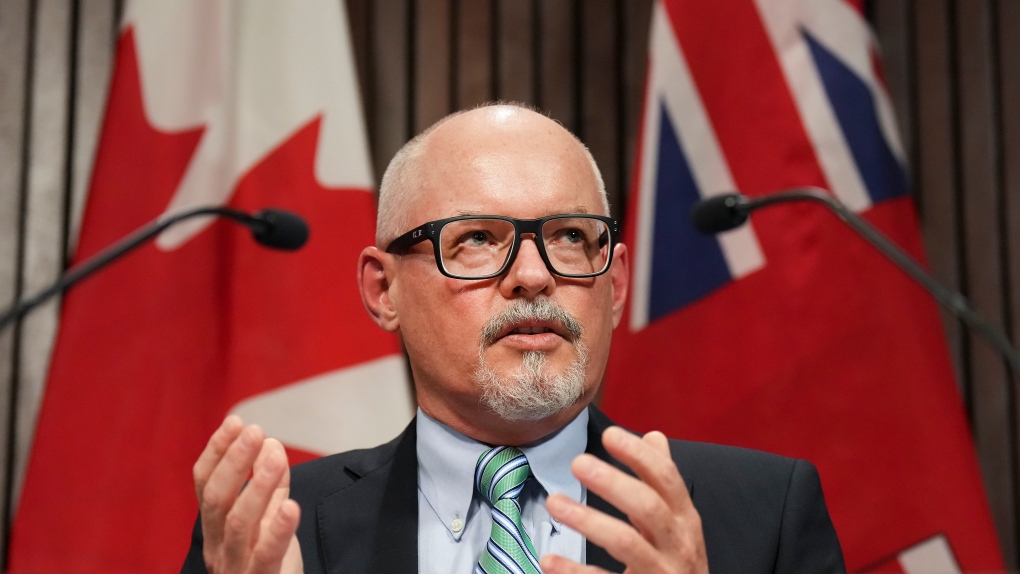
Chief Medical Officer of Health Dr. Kieran Moore said in an interview that he anticipates news on that will come next week on "both whether and how" to expand the rollout, but he said he is most concerned about the number of people who have not had a third dose yet.

"Of those five million that haven't had even their first booster, many of whom it's well after six months since their last dose, one million of them are over 50 years of age and we know age is a really significant risk factor for COVID, severe outcomes and hospitalization," Moore said.

"So we're asking first before we open up any further that one million, well all five million but one million over 50 who haven't come forward, please consider getting vaccinated in the month of July."

For people 59 and under a second booster may not give significant protection against severe outcomes because they were not at risk for severe outcomes to begin with, Moore said.

"We always do a risk-based strategy and a risk-based communication on the immunization rollout and if those (currently eligible) groups stop coming forward, and we see volumes of patients coming forward to be immunized are decreasing, we will increase the eligibility criteria," he said.

Ontario and Quebec are experiencing seventh waves of COVID-19, but health officials in both provinces are predicting they will soon peak.

Quebec public health director Dr. Luc Boileau said Thursday that while the highly contagious Omicron subvariants BA.4 and BA.5 are well established in Quebec and behind the rise in cases and hospitalizations, there are signs it will peak this month.

“We expect the evolution to curve down during the month of July, but there are uncertainties over that," he added. "The curve is slower than a week ago, so that's a small sign that we might get to the other side of it in the near future."

In Ontario, case numbers, positivity and hospitalizations were all on the rise. Moore said he expects Ontario could see the wave peak next week.

Moore said that if people decide to get their third dose now, it wouldn't prevent them from getting a new vaccine in the fall, should they become available.

Several vaccine manufacturers are racing to develop formulas that can target Omicron and Moore said it's hoped those are available in the fall. Ontario is planning to bring back a mass vaccination strategy for at-risk people if the so-called bivalent vaccines become available and inoculate up to 100,000 people a day.

If a bivalent vaccine is not available on that timeline, there is still "ample" supply of the original Moderna and Pfizer vaccines for the fall, Moore said.

Quebec Health Minister Christian Dubé encouraged Quebecers to get their COVID-19 booster shot. He said he had been considering waiting for his own fourth dose until September in the event a more effective vaccine became available.

Instead, Dubé, who is 65, decided to get boosted on Thursday. “It’s been more than three months (since my last dose). I’m in the category of people that if I caught it, I could be in more difficulty than someone who is 25 or 30,” Dubé said. If needed, he’ll get another dose in the fall after another three to four months have passed.

“I think when it comes to the booster dose, with the recommendations from public health, I was more comfortable getting it now. and I think others should do the same,” he said.

Officials said that despite the current uptick in COVID-19 indicators, they don't plan to reimpose new public health orders, such as mask mandates on public transit. Instead, officials urged those who are infected with COVID-19 to follow isolation guidelines and for those who haven't received a vaccination booster to make an appointment.

“I think the entire world is fed up with COVID, but I think we said all along that we need to live with this COVID,” Dubé said Thursday, adding that the situation is considered under control.

Boileau said one of the factors driving transmission is that infected people aren't respecting the province's 10-day isolation rules from the moment symptoms appear. Infected people should spend the first five days at home, then wear a mask outside for the following five days, he said.

“Basically, this is what explains the current wave: it’s the fact that those who have (COVID-19) are giving it to others," Boileau said. "Visibly, there are a lot of people not respecting (the rules) and it would be a good thing if they did."

On Thursday, Quebec reported 1,534 people hospitalized with COVID-19, a rise of 37 from the day before. Officials said 43 people were in intensive care, an increase of three. They reported another 16 deaths linked to the disease.

A weekly update released Thursday by Public Health Ontario showed a 20 per cent week-over-week increase in cases, a rise in the positivity rate from 8.4 per cent to 11.2 per cent, and indications that hospitalizations and deaths were rising.

Meanwhile, when asked whether there was any concern about a spike in COVID-19 numbers after the Calgary Stampede, Alberta Premier Jason Kenney noted travel isn't fully back to normal as airlines still struggle to run flights.

"But ... it's getting back to normal," he said.

Kenney said there were not many additional COVID-19 cases traced back to Stampede last summer – although he acknowledged that the virus continues to circulate in the province.

"We are, like the rest of the world, moving on with life. I don't want people in the summer of 2022, when we only have about 20 people in ICUs with COVID, I don't think people should be sheltering at home, living in fear. If there are people who are immunocompromised, they are always going to have to take some precautions.

"Like every other major event in the world, we are getting back to normal here and there's no reason to believe that can't be done safely and for good."

Adblock test (Why?)


More Ontario residents could be soon eligible for fourth COVID-19 vaccine dose | CTV News - CTV News Toronto
Read More

Soaring costs for food, energy push 71 million more people worldwide into poverty: UN agency - CBC News

A staggering 71 million more people around the world are experiencing poverty as a result of soaring food and energy prices that climbed in the weeks following Russia's invasion of Ukraine, the United Nations Development Program said in a report Thursday.

The UNDP estimates that 51.6 million more people fell into extreme poverty in the first three months after the war, living off $1.90 US a day or less. This pushed the total number globally at this threshold to nine per cent of the world's population. An additional 20 million people slipped to the poverty line of $3.20 a day.

In low-income countries, families spend 42 per cent of their household incomes on food, but as Western nations moved to sanction Russia, the price of fuel and staple food items like wheat, sugar and cooking oil soared. Ukraine's blocked ports and its inability to export grains to low-income countries further drove up prices, pushing tens of millions quickly into poverty.

"The cost-of-living impact is almost without precedent in a generation … and that is why it is so serious," UNDP administrator Achim Steiner said at the launch of the report.

The speed at which this many people experienced poverty outpaced the economic pain felt at the peak of the pandemic. The UNDP noted that 125 million additional people experienced poverty over about 18 months during the pandemic's lockdowns and closures, compared with more than 71 million who hit poverty in just three months after Russia's invasion of Ukraine in late February.

Over 5B in poverty or vulnerable to it 

"The speed of this is very quick," said George Molina, UNDP chief economist and author of the report.

Among the 20 countries hit hardest by inflation are Haiti, Argentina, Egypt, Iraq, Turkey, the Philippines, Rwanda, Sudan, Ghana, Kenya, Sri Lanka and Uzbekistan. More people in these countries, some of which have been roiled by political turmoil like Sudan and Sri Lanka, are facing poverty, according to the UNDP. In countries like Afghanistan, Ethiopia, Mali, Nigeria and Yemen, the effects of inflation are felt deeply by those already at the lowest poverty line.

The total number of people living in poverty, or are vulnerable to poverty, stands at over five billion, or just under 70 per cent of the world's population.

Protesters march toward the presidential palace during a demonstration over soaring living costs in Accra, Ghana, on June 29. The West African nation, reeling from a pandemic-spurred economic slump and hammered by the impact of Russia's war in Ukraine, saw inflation surge to more than 27 per cent last month, the highest level in almost two decades. (Nipah Dennis/AFP/Getty Images)

In Ghana, where the daily minimum wage is just $1.80 a day, people are struggling under the weight of inflation. Albert Kowfie, a 27 year-old security guard in Accra, Ghana, said a loaf of bread costs the equivalent of over $2 US and commuting to work costs another 20 cents.

"It means that by the end of the first week [of work], everything is gone," he said, expressing frustration at the government for not doing more to alleviate the burden. "I don't answer my mother's calls anymore because I know she needs help since she is not on any pension, but what can l do?"

People line up in front of a bakery to buy bread in Lebanon's southern city of Sidon on June 22, as a fuel and wheat shortage deepens. (Mahmoud Zayyat/AFP/Getty Images)

Another UN report released Wednesday said world hunger rose last year with 2.3 billion people facing moderate or severe difficulty obtaining enough to eat — and that was before the war in Ukraine.

There is a need for the global economy to step up, Steiner said, adding that there is enough wealth in the world to manage the crisis, "but our ability to act in unison and rapidly is a constraint."

Report calls for cash transfers

The UNDP recommends that rather than spending billions on blanket energy subsidies, governments instead target expenditure to reach the most impacted people through targeted cash transfers that can prevent a further 52.6 million people from falling into poverty at $5.50 a day.

For cash-strapped and debt-laden developing countries to achieve this, the UNDP called for an extension of debt payments that had been in place during the pandemic among the world's richest nations.

Darwin Manuel Santos, centre, receives food as he waits outside a shelter along with other immigrants in San Antonio, Texas on June 28. Every year, tens of thousands of migrants fleeing violence or poverty in Central and South America attempt to cross the border into the United States. (Chandan Khanna/AFP/Getty Images)

Steiner said doing so is not only an act of charity but is also "an act of rational self interest" to avoid other complex trends, such as economic collapse in countries and popular protests already taking place in communities across the world.

The war in Ukraine has roiled a region known as the world's bread basket. Before the war, Russia was the world's largest exporter of natural gas and the second biggest exporter of crude oil. Russia and Ukraine combined accounted for almost a quarter of global wheat exports and more than half of sunflower oil exports.

Adblock test (Why?)


Soaring costs for food, energy push 71 million more people worldwide into poverty: UN agency - CBC News
Read More

CitySwing On A Mission To Make Golf More Inclusive And Approachable - Forbes

Wednesday, July 6, 2022

More flights are scheduled in the U.S. than air traffic control can handle, say authorities - CBC News

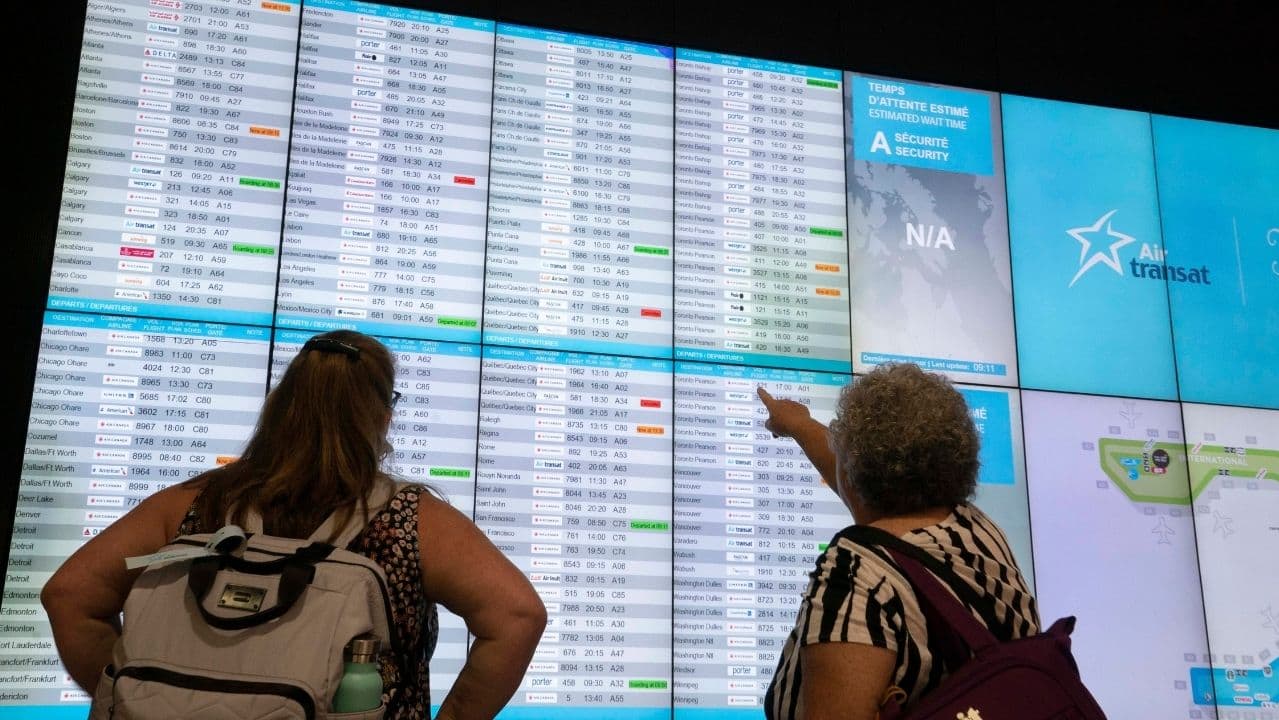
The U.S. aviation system is expected to "remain challenged this summer and beyond," and its federal regulator needs more air traffic control staff, a senior United Airlines executive said on Wednesday, echoing problems in Canada and Europe.

Travellers are already facing a tough summer with mounting flight cancellations amid rising demand as the industry tries to rebuild staff levels after thousands of workers left during the COVID-19 pandemic.

"The reality is that there are just more flights scheduled industry-wide than the [air traffic control] staffing system can handle," United's chief operations officer, Jon Roitman, said in a message to staff seen by Reuters.

"Until that is resolved, we expect the U.S. aviation system will remain challenged this summer and beyond."

The Federal Aviation Administration (FAA) responded, saying on Sunday and the holiday Monday, "there were no FAA staffing-related delays at all, yet airlines still canceled over 1,100 flights, a quarter of which were United Airlines flights."

The agency said it "will continue to meet our responsibility to hold airlines accountable, while standing ready to collaborate where appropriate so that Americans can confidently expect safe, reliable, and affordable service whenever they purchase an airline ticket."

A United Airlines plane sits near the terminal of the Ottawa International Airport in 2021. (Adrian Wyld/The Canadian Press)

U.S. Transportation Secretary Pete Buttigieg, who met June 16 with airline CEOs on summer travel issues, told CNBC on Tuesday that "air traffic control staffing issues do not explain the majority of delays and cancellations we've been seeing."

He cited as a key factor in flight issues the decision of airlines to push many pilots into early retirement despite $54 billion in COVID bailout funds.

European airlines hit by labour unrest

In Europe, strikes and staff shortages are forcing airlines to cancel thousands of flights and causing hours-long lineups at major airports, dashing hopes of a sizzling first summer after coronavirus lockdowns.

Paris airport workers will stage another walkout at the French capital's main international hub from July 8-10 to press their demand for a net monthly salary increase of 300 euro ($313.74 US).

WATCH | Canadian airlines among worst for delays, data shows: 

Canadian airlines among worst performers for delays, recent data shows

20 hours ago
Duration 1:48
Canada's two major airlines have had the poorest on-time performance of the 10 biggest North American airlines so far this summer, recent data shows. However, some experts say U.S. airlines experienced delays and disruptions last year due to a surge in demand for travel, and now, it’s Canada's turn.

Staff at an aviation fuel services firm at London's Heathrow Airport voted to carry out a strike over pay, the Unite union  said on Tuesday, with an initial 72-hour strike set to begin July 21.

Heathrow-based British Airways staff also plan to strike after the airline failed to roll back a 10 per cent pay cut imposed  during the pandemic, with the walkout expected to take place during the peak summer holiday period. On Tuesday, British Airways said it would reduce its April to October schedule by 11 per cent.

Several airlines have slashed their summer capacity to cope with the staff shortages, including thousands of cancellations by Lufthansa, easyJet and Air Canada.

Similar flight cuts and labour disputes have hit airlines in Spain, Portugal and other European countries. In Canada, experts say flight delays, cancellations and long lineups that have plagued airports in recent weeks are the result of labour shortages throughout the airline industry.

U.S. flight cuts

U.S. airlines have cut about 15 per cent of planned summer flights, an airline trade group said last month, while United Airlines has temporarily halted 12 per cent of departures from its Newark, N.J., hub alone because of congestion.

Over the four-day July 4 holiday weekend, 8.8 million passengers were screened by U.S. Transportation Security Agency checkpoints, topping 2020 and 2021, but about 12 per cent lower than 2019 levels.

Roitman said United performed better than major rivals over the holiday weekend but that "we still have some work to do to meet standards of reliability and operational performance."

WATCH | Widespread labour problems making airport chaos worse: 

Widespread labour issues making airport chaos worse, experts say

2 days ago
Duration 2:47
Experts say flight delays, cancellations and long lineups that have plagued Canadian airports in recent weeks are the result of labour shortages throughout the airline industry.

He added, "Yes, weather and air traffic constraints impacted the entire industry, but we've built a culture of 'no excuses' and we clearly have room to improve."

Last month, an airline industry trade group said the FAA must ensure adequate air traffic control staffing to avoid further summer travel disruptions, saying a key Florida ATC centre had been "understaffed for 27 of the last 30 days, which is crippling to the entire East Coast traffic flows."

Adblock test (Why?)


More flights are scheduled in the U.S. than air traffic control can handle, say authorities - CBC News
Read More

Lupus and other autoimmune diseases strike far more women than men. Now there's a clue why - CTV News

WASHINGTON - Women are far more likely than men to get autoimmune diseases, when an out-of-whack immune system attacks their own bodies -...