Rechercher dans ce blog

Sunday, August 28, 2022

Pakistan floods: Sindh province awaits more deluges and devastation - BBC

This video can not be played

To play this video you need to enable JavaScript in your browser.

One of Pakistan's southern provinces, Sindh, is bracing itself for worse to come as the country deals with catastrophic floods.

Deluges from swollen rivers are heading for lower-lying areas, officials say, threatening more misery for millions.

The floods have killed nearly 1,000 people across Pakistan since June, while thousands have been displaced - and millions more affected.

In Sindh, the message in every village the BBC visited was: "Send help."

In this province - which has a population of almost 50 million - there has been a little reprieve from the rains. But it will take more than a few days of sunshine to make life right again.

This year's floods have been devastating - and their impact is far from being fully realised.

The infrastructure was already basic in many rural communities. Many of the roads are not tarred, and some bridges are worn out after years of little maintenance.

But this can't just be blamed on poor infrastructure.

Pakistan's officials, who have dealt with floods many times before, say the hell unleashed by the heavens was nothing they could have prepared for.

This video can not be played

To play this video you need to enable JavaScript in your browser.

"People around the world talk about climate change and something it's only a theory," said one official, who has been running a relief operation in Larkana, a badly-hit city.

"We are seeing for ourselves on the ground that climate change is happening. We've never seen such rains in one year…now we need to think about how we build for the future - how do we even start?"

The torrents from swollen rivers in the mountainous north are due to arrive in the coming days. But the devastation is not isolated to Sindh province.

One man told the BBC his daughter had been swept away by a flooded river in northern Khyber Pakhtunkhwa province.

"She told me: 'Daddy, I'm going to collect leaves for my goat,'" said Muhammad Fareed, who lives in the Kaghan Valley.

"She went to the bank of the river and a gush of water followed and took her away."

Muhammad Fareed, whose daughter died in the Kunhar river

The US, UK, UAE and others have contributed to a disaster appeal, but more funds are needed, officials say.

According to reports by the Dawn newspaper, Pakistan's Prime Minister Shehbaz Sharif has announced a grant of 10bn rupees ($45m) for those in the most affected Khyber Pakhtunkhwa province.

Every flood-affected family would be given 25,000 rupees ($112), Mr Sharif said, which would be disbursed within a week.

Mr Sharif said 33 million people had been hit by the floods - about 15% of the country's population.

He said the losses caused by floods this season were comparable to those during the floods of 2010-11, said to be the worst on record.

Pakistan's Foreign Minister, Bilawal Bhutto-Zardari, echoed Mr Sharif's calls for more aid.

"I haven't seen destruction of this scale, I find it very difficult to put into words... it is overwhelming," he told Reuters.

  • Additional reporting by Farhat Javed in the Kaghan Valley

Banner saying 'Get in touch'

Are you affected by issues covered in this story? Do you have family or friends in the region? Please get in touch by emailing: haveyoursay@bbc.co.uk.

Please include a contact number if you are willing to speak to a BBC journalist. You can also get in touch in the following ways:

If you are reading this page and can't see the form you can email us at HaveYourSay@bbc.co.uk. Please include your name, age and location with any submission.

Adblock test (Why?)


Pakistan floods: Sindh province awaits more deluges and devastation - BBC
Read More

Ontario's population could grow by more than six million over the next two decades. Will we have the infrastructure to accommodate the boom? - CTV News Toronto

Ontario’s population could increase by as much as six million over the next two decades and some experts are warning that governments need to start “playing catch up” on building out the necessary infrastructure to accommodate that sort of influx before it is too late.

New projections released by Statistics Canada this week suggest that Ontario’s population will grow from 14.8 million to approximately 19 million by 2043 in a medium growth scenario and could even surpass 21 million in a higher growth scenario.

It is a good news story for the region’s economic prospects and vitality, most experts agree.

But it undoubtedly will pose a challenge for the Golden Horseshoe region, which is already struggling with a housing crisis and crippling gridlock.

“Population growth is really good and really important for the province. It helps fuel economic growth, it reunites families and it is great for the culture and the dynamism of our communities. But it also will continue to put pressure on our infrastructure which is already stretched,” Matti Siemiatycki, a professor and the director of the Infrastructure Institute at the University of Toronto, told CP24.com this week. “Infrastructure takes long-term planning, it is not something you can just flip a switch on.”

While there was a trend of people leaving the Greater Toronto Area for less expensive markets elsewhere in Canada during the pandemic, the new projections point to a rate of population growth in Ontario, which will exceed every province other than Alberta and British Columbia.

Most of that increase will be driven by immigration, continuing a longstanding trend in Canada, but the projections also point to an aging population, which could put additional pressure on things like the healthcare and long-term care systems.

In Ontario’s case, Statistics Canada says that the number of people over the age of 85 could rise from approximately 345,000 in 2021 to as much as 921,000 by 2043 in a medium growth scenario.

“We are definitely playing catch up because our systems are stretched at the moment. Housing is becoming increasingly unaffordable, you see our healthcare system struggling under the weight of the pandemic and then you see everything else. You know, when there are heavy rains, our sewer systems can’t accommodate them, we are having power outages, our cell phone services are vulnerable. So we are seeing what it is like when infrastructure creeks,” Siemiatycki warned. “With more people that will put even more pressure on the system and require us to be really strategic about which infrastructure we choose, how we build it out and then making sure it can handle the stresses it is going to face as our community grows.”

Ford government hopes to build 1.5 million homes by 2031

The Ford government has vowed to tackle the housing crisis by building 1.5 million new homes over the next decade, however a report released by the Smart Prosperity Institute at the University of Ottawa earlier this month warned that the province is unlikely to reach that goal.

Speaking with CP24.com, Siemiatycki stressed that population growth is still “very positive” at the end of the day as it means that “people are choosing Ontario and the GTA as a place that they want to come to and set up a new life,” in many cases starting businesses and contributing to further economic growth.

But Stacy Evoy, who is the president of the Ontario Real Estate Association, said that the projections are “scary” given a shortage of homes, which has inflated prices and forced many young people to abandon the communities they grew up in.

A survey released by Royal LePage last week, in fact, showed that only 22 per cent of GTA millennials who still harbour dreams of home ownership intend to purchase property in the communities they currently reside in.

“This release with these new numbers should be shouting to everyone that we are still not doing enough and really the dream of home ownership is on life support in Ontario,” Evoy told CP24.com this week. “Even if these projections are high and we see the influx on the low side – about 2.1 million people migrating to Ontario – I think that is of concern. We can’t even address the housing supply and the challenges that we are having at the current population level, let alone this huge influx over the next two decades.”

Evoy, who works as a real estate broker in the London area, told CP24.com that she routinely sees young people forced to move away due to the cost of housing in Ontario, leaving their families and support networks behind.

She said that she would like to see governments work together to find ways to add density in some residential neighbourhoods ahead of the coming population boom, including changes to zoning regulations that would remove some of the red tape around building multi-family homes like duplexes and triplexes.

The consequences of not doing so, she warned, could be dire.

“Rising interest rates might be masking the problem as prices dip but we are still in an affordability and housing supply crisis,” she said.

10 different scenarios

The Statistics Canada projections include 10 different scenarios, based on different immigration levels, life expectancy rates and fertility rates.

While there is considerable deviation among the different scenarios, all of them point to continued population growth in Ontario over next two decades.

Canada’s population as a whole is also expected to grow, rising from 38 million in 2021 to 56.5 million in 2068 under a medium growth scenario.

“At the moment we are really at a crossroads in terms of how our urban regions are going to grow,” Siemiatycki told CP24.com. “We are in a housing crisis and there is an urgent need to build more units but what form and where those are located is going to tell a lot of the story about the liveability of our cities for years to come. If we can find ways to intensify and do that while maintaining quality of life that will be a huge advantage for our cities. But if we continue to press outwards at the edge of our regions, eating into our prime farmlands, into our natural habitat, onto flood planes and marshlands that is going to be a pattern of growth that as the climate changes is going to be challenging.”

Adblock test (Why?)


Ontario's population could grow by more than six million over the next two decades. Will we have the infrastructure to accommodate the boom? - CTV News Toronto
Read More

Prime Minister launches Canada's first Federal 2SLGBTQI+ Action Plan to continue building a more inclusive future, with pride - Prime Minister of Canada

No matter who you are or who you love, you should have every opportunity to succeed in Canada. The Government of Canada has taken historic action in recent years to build a better, more inclusive future for Two-Spirit, lesbian, gay, bisexual, transgender, queer, intersex, and additional sexually and gender diverse people (2SLGBTQI+), and we know there is more to be done.

The Prime Minister, Justin Trudeau, joined by the Minister for Women and Gender Equality and Youth, Marci Ien, today launched Canada’s first Federal 2SLGBTQI+ Action Plan… Building our future, with pride, a whole-of-government approach to achieve a future where everyone in Canada is truly free to be who they are and love who they love.

The Action Plan will:

  • Prioritize and sustain 2SLGBTQI+ community action by supporting 2SLGBTQI+ community organizations in advocating for and serving the communities they represent;
  • Continue to advance and strengthen 2SLGBTQI+ rights at home and abroad including by building on the criminalization of conversion therapy and launching consultations on additional criminal law reforms, as well as continuing to invest in projects abroad through Canada’s Feminist International Assistance Policy;
  • Support Indigenous 2SLGBTQI+ resilience and resurgence including by continuing to fund Indigenous 2SLGBTQI+ community organizations, placing the “2S” to represent Two-Spirit people at the front of the 2SLGBTQI+ acronym, and creating a dedicated Two-Spirit Senior Advisor position within the 2SLGBTQI+ Secretariat;
  • Engage everyone in Canada in fostering a more inclusive future by investing in awareness campaigns to improve understanding of 2SLGBTQI+ communities and issues;
  • Strengthen 2SLGBTQI+ data and evidence-based policy making by improving data collection, analysis, research, and knowledge on 2SLGBTQI+ communities and the barriers they face in Canada; and
  • Embed 2SLGBTQI+ issues in the work of the Government of Canada by ensuring coordinated action to advance 2SLGBTQI+ priorities across federal government organizations.

Budget 2022 committed $100 million over five years to develop and implement the Action Plan to benefit 2SLGBTQI+ people. The Prime Minister today also announced that this includes:

  • Up to $75 million for 2SLGBTQI+ community organizations that advocate for and serve their communities:
    • $40 million in new capacity-building support, prioritizing funding for 2SLGBTQI+ communities experiencing additional marginalization, such as Black, racialized, and Indigenous 2SLGBTQI+ communities, 2SLGBTQI+ persons with disabilities, seniors, youth, official language minority communities, and those living in rural communities; and
    • $35 million in new project-focused support aimed at addressing specific barriers to 2SLGBTQI+ equality.
  • $11.7 million for the 2SLGBTQI+ Secretariat to oversee and implement the Action Plan;
  • $7.7 million for data collection and community-led policy research to support federal action on 2SLGBTQI+ issues; and
  • $5.6 million to develop and implement awareness campaigns that focus on breaking down stigma and ending discrimination for 2SLGBTQI+ Canadians.

The Action Plan was developed with community leaders, researchers, and organizations. It speaks to the concerns of diverse members of 2SLGBTQI+ communities across the country and uses an intersectional, holistic, and long-term approach to breaking down barriers and fighting the discrimination and oppression of 2SLGBTQI+ Canadians.

Building on the historic action already taken, the Action Plan is an evergreen document that continues to celebrate Canadians for who they are. While it is a historical first, the work does not end here – this Action Plan will continue to guide our work into the future. The Government of Canada will continue to work with provinces and territories, cities and towns, community organizations, and 2SLGBTQI+ people from all walks of life to build a better future we can all be proud of.

Quotes

“Canada gets a little bit stronger every day that we choose to embrace and to celebrate who we are, in all our uniqueness. We are a diverse nation enriched by the lives, experiences, and contributions of 2SLGBTQI+ people. Let us celebrate all the communities that make Canada such a diverse country, and work together to build a better future, with pride.”

The Rt. Hon. Justin Trudeau, Prime Minister of Canada

“Canada’s 2SLGBTQI+ Action Plan is a historic collaborative effort that will help build a more inclusive country. Founded on the hard work of community members, organizations, and allies, this Action Plan will set an example for generations to follow. I can assure you that the work does not end here – we will continue to partner with 2SLGBTQI+ communities and leaders to make sure we’re building a Canada that serves everyone.”

The Hon. Marci Ien, Minister for Women and Gender Equality and Youth

Quick Facts

  • Terminology and acronyms are continuously evolving. Based on extensive consultation with 2SLGBTQI+ communities across the country, the Government of Canada will adopt and encourage the use of the 2SLGBTQI+ acronym (2ELGBTQI+ in French), which is more inclusive and places the experiences of Indigenous 2SLGBTQI+ communities at the foreground as the first 2SLGBTQI+ peoples in North America. It stands for Two-Spirit, lesbian, gay, bisexual, transgender, queer, intersex, and additional sexually and gender diverse people.
  • Between fall 2020 and summer 2021, the Government of Canada undertook a community engagement process to inform the development of the 2SLGBTQI+ Action Plan, including 25,636 survey responses, 102 written submissions, and roundtable discussions with over 100 participants.
  • The Government of Canada has taken historic action in recent years to advance equality and create better opportunities for 2SLGBTQI+ Canadians, including:
    • In 2016, the Prime Minister appointed a Special Advisor on LGBTQ2 issues, and shortly thereafter, created what is now called the 2SLGBTQI+ Secretariat with the mandate to provide the federal government with pathways to address historical and ongoing injustices experienced by 2SLGBTQI+ people in Canada;
    • In 2017, the Canadian Human Rights Act and the Criminal Code were updated to protect gender identity and gender expression;
    • In 2017, the Prime Minister apologized in the House of Commons for the systemic oppression, rejection, and criminalization of Canadians identifying as lesbian, gay, bisexual, transgender, queer, and Two-Spirit;
    • In 2018, the Federal Court approved the LGBT Purge Class Action Final Settlement Agreement;
    • In 2018, the Expungement of Historically Unjust Convictions Act for eligible offences involving consensual same-sex sexual activity became law;
    • In 2019, the government repealed anal intercourse, vagrancy, and bawdy house offences from the Criminal Code;
    • In 2019, the government announced targeted programming for 2SLGBTQI+ communities, including the Community Capacity Fund and advancing 2SLGBTQI+ rights globally through Canada’s Feminist International Assistance Policy;
    • In 2022, an Act to Amend the Criminal Code (Conversion Therapy) became law, criminalizing this cruel, harmful, and degrading practice; and
    • In 2022, the Prime Minister launched Canada’s first Federal 2SLGBTQI+ Action Plan.

Associated Links

Adblock test (Why?)


Prime Minister launches Canada's first Federal 2SLGBTQI+ Action Plan to continue building a more inclusive future, with pride - Prime Minister of Canada
Read More

Saturday, August 27, 2022

More seniors turning to Quebec food banks as grocery costs soar - CBC.ca

Claudette Cazeneuve knows how hard it can be making that first trip to a food bank, but she wants people to know there's no shame in getting help.

She used to dread the trips to Super-C because of the prices.

"We had two little shopping bags and it cost us close to $100," said Cazeneuve, who usually shops alongside her daughter.

"I would go around and think, 'Oh God not this week.'"

The 83-year-old lives on a fixed income, her budget stretched thin over recent months with the exploding costs at grocery stores.

"For me, it's a big help," said Cazeneuve. "I wouldn't have said that six months ago, but now we need it."

Lisa Stivaletti, a volunteer with the Hope Food Bank in LaSalle, says people over 60 currently make up a large part of their clientele.

"They're dipping into savings and they're having a hard time making ends meet," Stivaletti said. "There's also adult children who are now coming in for their parents."

Inflation reached 8.1 per cent in Canada in June, a 39-year high according to Statistics Canada. Since last May, that's included a rise of 8.8 per cent in the cost of food.

More students and the "working poor" are also turning to food banks, a shift in demographics since the pandemic, said Martin Munger, executive director of Food Banks of Quebec.

'Poorer by the minute'

It's seniors on fixed incomes paying the biggest price when it comes to inflation, said Pierre Lynch, a seniors' rights advocate in the province.

Over 700,000 in Quebec rely on a federal pension of $20,000 per year, he said. When you factor in inflation, that's a loss of about $1,600 this year in purchasing power.

"The most vulnerable people in our society are really struggling and in fact … all the other ones that are making $21,000 or $23,000 are slipping slowly down to that group," said Lynch, the president of the Association quĂ©bĂ©coise de dĂ©fense des droits des personnes retraitĂ©es et prĂ©retraitĂ©es.

"They're getting poorer by the minute," he said, saying provincial and federal pensions need to be indexed to inflation.

WATCH | Food banks see increased demand while donations dwindle:

Montreal food banks are seeing more demand and fewer donations

1 month ago

Duration 5:09

Suzanne Scarrow of the West Island Mission says demand has exploded in the last few months due to the rising cost of living. They are also seeing fewer donations from the community and corporate partners.

It's an even more dire situation for the two thirds of seniors in province that don't have employment income or their own pension plan.

"There's just a lack of political courage," Lynch said.

A single adult needs roughly $28,783 per year to live comfortably in Montreal, according to a December 2021 estimate by Institute for Research and Development on Inclusion and Society.

Beyond covering basic needs, that also covers expenses that can come with unexpected emergencies.

"Fruits, vegetables, meats, eggs: we've seen inflation on most of these products. The price of gas is also significantly higher, and this is what is so hard about the current situation," said Sebastien Betermier, an associate professor of finance at Desautels Faculty of Management at McGill University.

With geopolitical issues like the war in Ukraine driving inflation, the economist says it's unpredictable when costs could come down. He recommends planning ahead for at least the next two years to see where costs can be cut.

"Just planning ahead eases the anxiety that we face, and it becomes a lot more manageable," he said.

Adblock test (Why?)


More seniors turning to Quebec food banks as grocery costs soar - CBC.ca
Read More

'Today is a fantastic day': Manitoba welcomes more than 320 Afghan refugees - CBC.ca

Tears welled up in Sayed Najib Amin's eyes and his voice cracked between sobs as he waited for his young nephews to arrive at Winnipeg's international airport on Friday, exactly a year after the boys' parents were killed in Kabul.

After months of anticipation and delays, a charter plane from Pakistan carrying 324 Afghanistan refugees — including 120 children — landed in Winnipeg.

Among the arrivals were two boys, age 2½ and four. They are Amin's orphaned nephews.

"We suffered a lot, so today is a fantastic day. It's the happiest day of my life," Amin said. "I can't wait to hold my nephews in my arms.

"Can't wait to see them. Can't wait to hug them. Can't wait to share my feelings with them. Can't wait to love them."

A young Afghan refugee waves a small Canadian flag after arriving at Winnipeg's international airport. (Jaison Empson/CBC)

The boys' parents — Amin's brother and sister-in-law — were killed by a suicide bomber near the Kabul airport exactly a year ago, on the day they were set to fly out of Afghanistan.

Following their parents' deaths, the boys went to live in Pakistan with another uncle and his wife, who also made the trip to Winnipeg on Friday.

Sayed Najib Amin is in Winnipeg after flying from Montreal to pick up his young nephews, who were orphaned when Amin's brother and sister-in-law were killed by a suicide bomber at the Kabul airport. (Randall McKenzie/CBC)

Amin, who lives in Montreal, flew into Winnipeg on Thursday to greet them all and take them back Montreal to live with his family.

"We were counting every second of our life [to get them]. God gave me another life today," Amin said.

"I can't describe it, how happy and emotional I am."

Kabul, the capital and largest city of Afghanistan, fell to the Taliban on Aug. 15, 2021. The country has since faced a humanitarian crisis, with millions of people struggling to find food, while women and girls have lost basic rights.

Friday's flight is part of the government of Canada's commitment to resettle 40,000 Afghan people in Canada. 

Immigration, Refugees and Citizenship Canada told CBC News that nearly 17,600 Afghans and their family members have arrived in Canada since August 2021. More charters with Afghan refugees are expected to arrive in Canada in the coming weeks.

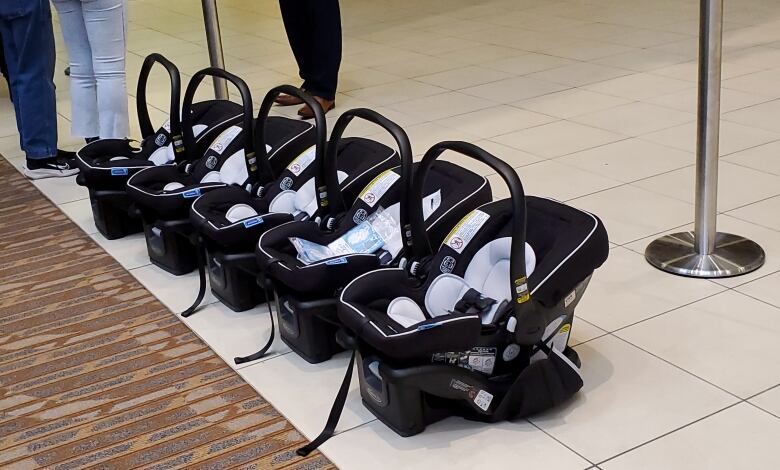
Child car seats await to be gifted to some of the refugees. Among the 324 refugees are 120 children. (Meaghan Ketcheson/CBC)

Friday's flight also included more than 160 refugees who are former interpreters for the Canadian Armed Forces, said Shozub Hussain Butt, an operation assistant for the flight who works with the International Organization for Migration, a United Nations agency.

"They are happy, they are very much happy. Their hopes are very high now."

Canada withdrew its military presence from Afghanistan in 2014, after an international military coalition toppled the Taliban-ruled Islamic Emirate in 2001 and eventually helped establish the Islamic Republic.

In 2021, a Taliban resurgence overthrew the Islamic Republic and re-established the Islamic Emirate. Insurgents then started targeting Afghans with ties to the former government, exacting revenge on interpreters who helped international forces.

Amin said his brother, killed by the suicide bomber, had been an interpreter for the U.S. military.

The flight on Friday was originally supposed to arrive last month but was delayed, which made the wait seem so much longer, Amin said.

A young child looks wide-eyed at the crowds in the Winnipeg airport after arriving on a charter flight on Friday. (Jaison Empson/CBC)

But the day finally arrived "and I'm not living in the past anymore," Amin said. "I'm a present person."

Among the arrivals was a family of six led by a man name Ali, who had been an interpreter for the Canadian Forces in Kandahar.

When the Taliban started taking over parts of Afghanistan again, Ali and his family went into hiding.

"It was very difficult to survive. We were hidden in our homes," he said, not wanting to give his last name because he is part of a protected group. "And finally, thank God, we reached here."

He arrived with his wife and daughter, his two sisters and their mother.

Ali repeatedly said "thank you" to reporters and Canada as he spoke. He is now waiting to find out where exactly in his new country he will end up.

WATCH | Sayed Najib Amin reunites with his nephews from Afghanistan:

Emotional reunion as uncle reunites with orphaned nephews

16 hours ago

Duration 0:57

Sayed Najib Amin is in Winnipeg after flying from Montreal to pick up his young nephews, who were orphaned when Amin's brother and sister-in-law were killed by a suicide bomber at the Kabul airport.

Boris Ntambwe, resettlement and housing manager for Accueil Francophone, a settlement service for Francophone newcomers, immigrants and refugees in Manitoba, said 115 of the refugees will go to Brandon, Winkler and Winnipeg, and the rest will settle in different parts of Canada. 

"We are going to offer them, first of all, a place … [to] have food and relax a little bit and have an intake and have immediate assessment to see if there's any urgent needs that need to be addressed, any medical or health issues," he said. 

The not-for-profit organization had people at the airport to welcome the refugees and has been anticipating their arrival since early July.

Boris Ntambwe, a resettlement and housing manager for Accueil Francophone, has been collaborating with other not-for-profits, hospitality businesses and airports to help welcome over 300 Afghan refugees to Canada. (Karen Pauls/CBC)

"It kept on being postponed and it hasn't been easy at this particular moment of time.… Hotels are booked all over the place. We are receiving Ukrainians, receiving Afghans, so it's all packed and full," said Ntambwe, who has been managing the many moving parts of Friday's arrival.

He has been collaborating with airlines, hotels, airports, catering services and health services so the Afghans have what they need, he said.

Westman Immigration Services is prepared to take 50 of the refugees to Brandon — the largest intake of refugees the organization has ever had at once.

They will then help sort out temporary and permanent accommodations and provide families with a needs assessment, a Westman Immigration Services spokesperson said. 

The people moving on to other destinations within Canada will spend a few days in Winnipeg before continuing their journey.

Ariana Yaftali, who was born in Kabul and co-founded the Afghan Canadian Women's Organization, is one of the volunteers providing support to the newcomers.

She knows from personal experience how overwhelmed and emotional refugees can be when they arrive.

"We will provide that critical support, which is assuring them that now they are in a safe place, they are in Canada, where we have respect for human rights. They are free from any form of violence [and] persecution," Yaftali said.

She hopes she can be a role model and help them navigate things like preparing for the winter weather and enrolling kids for school — challenges Yaftali dealt with when she first arrived in Canada.

"If they see people like me and community members, or people who have been through this journey ... then they can see, oh, you know what? This person can make it, and I can make it too."

WATCH | Manitoba welcomes more than 320 Afghan refugees

Adblock test (Why?)


'Today is a fantastic day': Manitoba welcomes more than 320 Afghan refugees - CBC.ca
Read More

Peel police used force on Black people 3.2 times more than their share of population last year: new data - CBC.ca

Peel Regional Police used less force on Black people last year compared to 2020, but still did so 3.2 times more than Black people's share of the population, new data shows. 

Police used force against 289 Black people in 2021 compared to 345 the year before, signalling a 16 per cent drop, according to an annual use of force report presented to Peel's police services board Friday. 

However, Black people make up less than 10 per cent of Peel Region's total population, according to the latest census figures from Statistics Canada, dated 2016. The group accounted for 32 per cent of all use of force reports — the highest out of seven different racial groups including white, East and Southeast Asian, South Asian, Middle Eastern, Latino and Indigenous.

Akwasi Owusu-Bempah, a professor at the University of Toronto working with Peel police change training and policy, says the fact that Black people are three times more likely than their representation in the general population to be subject to use of force signals that "something needs to be done".

In 2020, Peel police were thrust into the spotlight after the high-profile deaths of multiple Black people and people of colour in crisis including Jamal Francique, D'Andre Campbell and Ejaz Choudry. That was fuelled further by the global Black Lives Matter movement following the death of George Floyd in Minneapolis.

CBC News planned to interview Peel Regional Police Supt. Dirk Niles on Friday, however the force cancelled the interview approximately 30 minutes before it was set to begin. 

The report concedes that the collection of race-based use of force data in its current form "severely limits" the ability to analyze whether certain police procedures may be contributing to "disproportionalities or disparities in relation to race."

"The current form does however accurately capture a great deal of information about police-public interactions," it reads.

Use of force down in most groups

Data shows the total count of use of force applications dropped from 1,114 in 2020 to 940 in 2021, representing a 15 per cent decrease.

All groups except for East and Southeast Asian, Middle Eastern and Indigenous groups showed a decrease in use of force incidents —  police attributed the increase in force against people of Middle Eastern and Indigenous descent to multiple reports made for the same individual. 

Captured above is Table 4 of the 2021 Annual Use of Force Report, representing the number of applications of force on an individual, grouped by perceived race of an individual, by an officer. Each type of force used represents an application of force. (2021 Annual Use of Force Report)

Police can use varying types of force, ranging from conducted energy weapons (better known as Tasers) and physical control, to pepper spray and firearms.

Out of 1,121 use of force applications, Peel police used most commonly used Tasers, physical control and firearms.

Last year, Peel police drew Tasers the most at 438 times — representing a six per cent increase from 2020 — and used them about 52 per cent of the time. Police used physical force 304 times — about a 14 per cent increase from 2020.

Police drew firearms 338 times and intentionally discharged 12 times in 2021, but say 10 of those reports involved firing at an animal.

The top three most commonly cited reasons for using force were for arrest, to protect officers and to protect the public. 

Police's handling of crisis calls

The report states crisis calls accounted for 6,726, or about two per cent, of total police calls last year. It adds use of force incidents involving someone in crisis decreased slightly from 53 in 2020 to 48 in 2021.

But this lawyer says police have no business handling crisis calls at all. Rick Frank helped represent the Black Action Defence Committee this spring in an inquest into the 2015 death of Marc Boekwa Diza Ekamba. 

Seven years ago, Peel police opened fire after Ekamba stabbed two officers with a kitchen knife and refused to drop it. Advocates have said police intervention would not have been necessary if Ekamba and his family had gotten the mental help they needed. 

Marc Ekama was killed by Peel Regional Police on March 20, 2015, as a result of multiple gunshot wounds. A coroner's inquest into his death started on May 16, 2022 and ended in June. (Coroner’s Constable)

"The officers repeatedly said, 'We don't see race, I don't see colour' and for me, that goes against what the report shows," said Frank, of the Peel officers who testified.

"The force needs to change that and have the officers recognize this is something we need to change — all of us, individually and collectively."

In 2020, Peel police took on a mandatory Human Rights Focused training strategy developed with the Ontario Human Rights Commission and Owusu-Bempah, the report states, which focuses on "de-escalation, accountability and ensuring the dignity of all members of the community."

The inquest led to 35 broad-reaching recommendations to police forces across Ontario to strengthen training in anti-Black racism, implicit bias and mental health awareness.

When asked to comment on the suggestions, Peel police said they supported a number of recommendations, but also tried to ensure that they were all relevant to the inquest, implementable and would "effect positive change".

Wait and see, researcher says 

Owusu-Bempah, the researcher who presented the report alongside Peel police Friday morning, says while the report show progress, it's too early to say just how much.

Akwasi Owusu-Bempah is a faculty member at the department of sociology at the University of Toronto. According to Peel Regional Police, collaboration with Owusu-Bempah and his academic team is currently underway to create a five-year force wide study of how well officers are applying their human rights-focused skills in deescalating situations in order to avoid use of force encounters. (Oliver Walters/CBC)

"While the year-over-year trends are heading in the direction we might want them to head in, we need much, much more data over a longer period of time to be able to signal whether that trend is sustained," said Owusu-Bempah, who specializes in the intersections of race, crime, criminal justice, and policing.

Owusu-Bempah notes it could be a positive sign that there is no major difference in the types of force used against members of different racial groups, or the number of officers involved in occurrences involving members of different races. 

"We really need to wait and see how sustained any kind of changes are," said Owusu-Bempah. 

Adblock test (Why?)


Peel police used force on Black people 3.2 times more than their share of population last year: new data - CBC.ca
Read More

These Ontario libraries say more people borrow items and return them on time after overdue fines dropped - CBC.ca

An interesting thing happened at the Kitchener Public Library in Ontario after overdue fines were eliminated: More people started returning their borrowed items on time.

Mary Chevreau, the library's chief executive officer, said when fines were originally introduced, it was to motivate people to bring back their items on time, but now, "it's sort of reverse psychology."

"Those who, of course, could afford to not bring them back on time couldn't care less whether they paid the fine or not, and others who didn't bring them back on time … would bring them back late, but wouldn't pay the fines," she told CBC News.

Now, "people bring their items back more on time than ever before."

Kitchener Public Library CEO Mary Chevreau says staff have reported more borrowed items are being returned on time since the library went fine free. (Jackie Sharkey/CBC)

A growing number of Ontario libraries have opted to do away with fines for overdue books and other items because they're seen as a barrier for many people.

Kelly Bernstein, CEO of the Brant Public Library and member of the Ontario Library Association's research and evaluation committee, said more than 80 libraries in the province have stopped issuing fines on a temporary or permanent basis.

When fees were introduced, it was seen as a way to encourage people to return materials on time. It was thought a fine of as little as 10 cents a day would be enough incentive to get books and other items back on their due dates, but when people were days late with multiple items, they could accumulate a significant fine.

Bernstein said research showed some people felt "shame or fear of huge bills that drives them away" and some felt they couldn't enter a library to access computers, services or programs.

Getting rid of fines means staff can focus on recommending books or helping people access services "rather than have awkward conversations about owing $5," Bernstein said in an email.

"The sad truth is, there are lots of people who can't afford to pay that $5, so they avoid the library entirely."

'Totally worth' not fining borrowers

Bernstein said some libraries may have concerns about going fine free, "but it's totally worth it."

When people were charged overdue fines, she'd often see parents trying to impose their own limits on how many books their children could borrow.

"When my library went fine free in 2019, I remember a single dad who brought his two girls to the library every week. He was so delighted and visibly relieved to tell his kids they could take home as many books as they wanted," she said. 

"I can still picture a young boy who said to us, with huge eyes, 'You mean I can take more than one?' That's the kind of joy that we want everyone to feel when we use the library."

In the northern Ontario town of Cochrane, the library's collection services technician, Ardis Proulx-Chedore, said going fine free has resulted in an increase in patrons, including more children and families "than ever before." 

"Just the basic concept that libraries are not going to pester you for a few bucks really seems to have encouraged usage of our resources," Proulx-Chedore said in an email.

"In retrospect, we have even noticed that monetary donations are up from those who do end up with overdue materials. They do not feel the pressure of a mandatory fine, so sometimes people give from their heart."

A woman returns a book to a Vancouver Library branch in this file photo. The Ontario Library Association's research and evaluation committee has created a tool kit to help libraries who want to go fine free. (Ben Nelms/CBC)

Anjana Kipfer, manager of marketing and communications at Waterloo Public Library, has noticed going fine free has changed how people feel about the library.

The library is among those that temporarily eliminated fees early in the COVID-19 pandemic. It decided to do away with fines permanently earlier this year.

"People have come in and said they are now using the library for the first time because they're able to kind of get these items, and if they are a day late or something, they don't feel stressed out about having to return those items," Kipfer said in an interview.

The Ottawa Public Library did away with overdue fines in January 2021. Spokesperson Anthony Langlois said 95 per cent of people with items deemed "lost" had returned them in the first quarter of that year, amounting to more than $500,000 worth of recovered materials.

"To date in 2022, [the library] has seen close to 99 per cent of materials returned on time or within three weeks of the due date," Langlois said.

Revenue from fines 'extremely low'

Bernstein said the Ontario Library Association's research and evaluation committee created a toolkit to help libraries make the case of going fine free to stakeholders.

"Staff time and resources can be more expensive than you think," Bernstein said. "For every $5 collected in fines, it can cost up to $5.95 to collect it. There are also costs that are harder to quantify; staff morale and patron shame are huge factors."

Parents and children take part in a storytime at Guelph Public Library's east-side branch. Michelle Campbell, the library's manager of public service, says they've noticed a trend where people are 'coming back feeling comfortable using the library again.' (Kate Bueckert/CBC)

Since going fine free on Jan. 1, the Guelph Public Library has registered more than 4,000 people as library patrons — a five-year high. Michelle Campbell, the library's manager of public service, said that includes people who are new to the library and individuals who allowed their memberships to lapse.

"We're noticing an upward trend that way as well in terms of those people coming back feeling comfortable using the library again."

Campbell said while they knew getting rid of fines would mean a loss of revenue, "it's not really the job of the library to make money." As well, the amount of money the library brought in from overdue fines was "extremely low and had just been getting lower."

Helen Kelly, CEO of the Idea Exchange in Cambridge, which went fine free in January, said they've seen a 38 per cent increase in new memberships this year over the same period in 2021.

"In the first half of 2022, we have seen a 66 per cent increase in borrowing of physical materials compared to the same period last year." Kelly said.

"As one member told us, 'You truly are a lifeline.'"

Adblock test (Why?)


These Ontario libraries say more people borrow items and return them on time after overdue fines dropped - CBC.ca
Read More

Lupus and other autoimmune diseases strike far more women than men. Now there's a clue why - CTV News

WASHINGTON - Women are far more likely than men to get autoimmune diseases, when an out-of-whack immune system attacks their own bodies -...