To play this video you need to enable JavaScript in your browser.
By Jay Savage
BBC News, Sydney
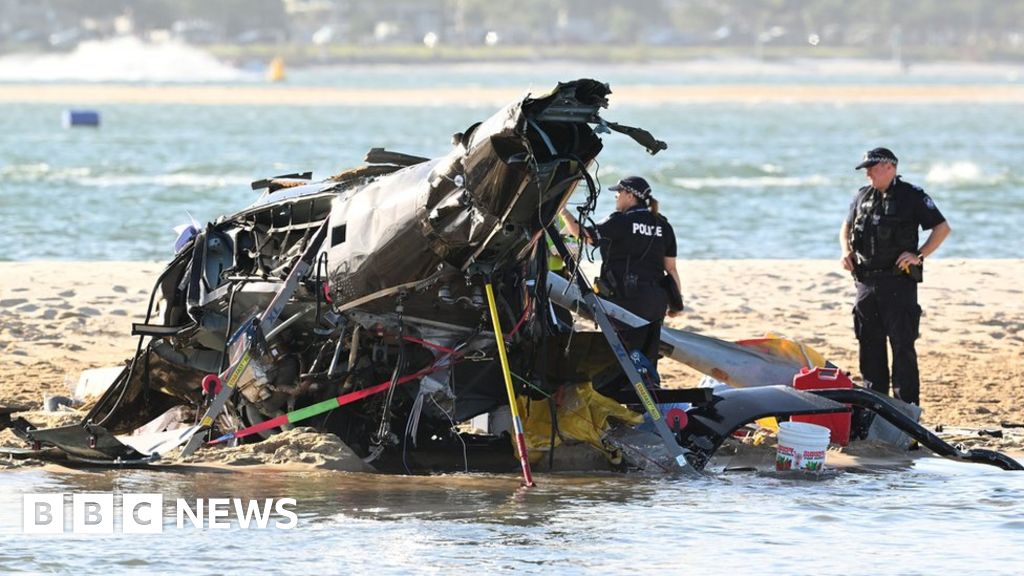
A mid-air collision between two helicopters in Australia could have seen many more deaths, authorities say.
A British couple and two Australians died in the crash on Monday near Sea World on Queensland's Gold Coast.
Three others - including two children - were seriously injured.
The cause of the crash is not yet known. Officials say it happened less than 20 seconds after one helicopter took off from a sandbar and collided with another aircraft that was landing.
All those killed and critically injured were in the ascending helicopter, which crashed within seconds after its main rotor blade struck the cockpit of the other aircraft, the Australian Transport Safety Bureau (ATSB) said.
The second helicopter landed upright on the sandbank. Five of the six people on board suffered minor injuries.
The landing was a "remarkable achievement" given the helicopter was damaged "where the pilot was sitting", ATSB chief commissioner Angus Mitchell said.
"We are very fortunate that we're not standing here with far more deaths," he told reporters on Tuesday.
The UK victims - a woman, 57, and a man, 65 - were married and had a next of kin in Australia, Queensland Police said. They and another woman who died, a 36-year-old Australian, have not been identified.
The fourth victim was 40-year-old Ashley Jenkinson, an experienced Sea World Helicopters pilot who lived in the area.
Mr Jenkinson was a "big guy with a big heart", said one friend quoted by local media. The Brisbane Times reported he was originally from England and had helped with recovery efforts after devastating floods in Lismore, New South Wales, last year.
A boy, 10, and a woman, 33, remained in a critical condition in hospital on Tuesday, police said. A nine-year-old boy with serious injuries was described as stable.
Both helicopters were operating tourist flights for Sea World - one of several popular theme parks on the Gold Coast. Its owner, Village Roadshow Theme Parks, has offered condolences and said Sea World Helicopters is an independent operator.
The ATSB says it will conduct interviews and meticulously scour the helicopters, scene, footage, and other evidence before speculating on what caused the crash. It called on eyewitnesses to come forward.
Police said boat operators had rushed to help after the crash at about 14:00 local time (04:00 GMT), including by giving CPR.
Authorities had faced challenges accessing the sandbank and later securing evidence amid tidal changes, officials said.
The ATSB's preliminary report is due in six to eight weeks.
Prime Minister Anthony Albanese said the country had been left shocked by the "terrible and tragic incident".
The UK foreign office has said it is supporting the victims' families and will remain in contact with local authorities.
New figures released by British Columbia's property assessment agency show the province's most valuable residential property, which is owned by billionaire Lululemon founder Chip Wilson, is worth about $1 million more than it was in the previous year's assessment.
Wilson's seven-bedroom, nine-bathroom mansion on Vancouver's Kitsilano waterfront is valued at $74,089,000, an increase of 1.3 per cent or $942,000 from the previous year, according to B.C. Assessment,
The 2023 numbers, based on market valuations from July 2022, were posted online Monday.
The agency warned in December that 2023 assessments would likely not reflect the current market because of the six-month lag and the effects rising interest rates and slowing sales are having on the residential property sector.
"As a result, your next property assessment will likely be higher than what the current market value might be, but that will be the same for everyone,'' assessor Bryan Murao said in a statement.
Rates for a conventional five-year mortgage have risen from about 3.5 per cent one year ago to almost six per cent.
B.C. Assessment has released its 2023 property values online based on valuations from July 2022. (Gian-Paolo Mendoza/CBC)
According to the latest data from the Real Estate Board of Greater Vancouver, home sales in the city were down almost 53 per cent in November 2022 compared with a year earlier, and down 15 per cent from October 2022.
Still, Murao said most property owners can expect to see a five to 15 per cent increase in their 2023 assessment.
Assessment notices will be mailed out to owners this month.
B.C. Assessment will be releasing more information on specific regions, communities and market trends on Tuesday.
As the premiers and the federal government continue to battle over health-care funding, leading doctors and experts say that while more government money is needed, the way health care is delivered in Canada also needs to change.
The issue is dominating the national conversation now as patients find themselves let down by a shortage of doctors and nurses, overwhelmed pediatric hospitals and a backlog in necessary but elective surgeries.
The Children's' Hospital of Eastern Ontario (CHEO) recently had to accept staffing help from the Canadian Red Cross as it struggles with a surge in hospitalizations caused by respiratory viruses like influenza, RSV and COVID-19.
Alex Munter, CHEO's CEO, said the hospital has just experienced its "busiest May, June, July, September, October and November" in its 50-year history.
Have a question or something to say? Email: ask@cbc.ca or join us live in the comments now.
The Alberta Children's Hospital in Calgary is facing a similar situation. It set up a heated trailer next to its emergency room as it continues to operate beyond 100 per cent capacity.
"We are seeing a greater number of children significantly unwell, requiring hospitalization at a given time in a short period, than we have probably ever seen before," said Dr. Stephen Freedman, a professor of pediatrics at the University of Calgary.
"Our biggest challenge in our emergency right now in Calgary is often space to see kids. We've started therapy, but there's nowhere for them to move to. So they're stuck in the emergency department for 24, 36 hours."
Experts say that hospitals and family practices in Canada were built to operate at almost full capacity all the time. When the system experiences spikes in need, doctors and nurses simply work longer hours to meet the demand. But the system was operating over peak capacity for a long time during the pandemic — and doctors and nurses started burning out.
The Canadian Medical Association (CMA) surveyed its members and found 53 per cent of doctors were reporting burnout in 2021, compared to 30 per cent in 2017. A similar survey of 5,200 nurses by the Registered Nurses Association of Ontario found more than 75 per cent of nurses qualified as burnt-out in 2021.
Canadian Medical Association president Dr. Alika Lafontaine, right, with colleague Dr. Sunelle Strydom at Grande Prairie Regional Hospital. (Dr. Brian Goldman/CBC)
"It is like driving around with only $5 in the gas tank, knowing that winter is here, knowing that a day that's minus 30 is just around the corner, but then not changing the approach and idling and then running out of gas," said CMA president Dr. Alika Lafontaine.
Dr. Lafontaine said that if doctors and nurses continue to burn out on the job, the system will deteriorate further.
Canada has a well-documented shortage of doctors and nurses — a problem made worse, doctors say, by the increasing administrative burden they face.
The CMA says family physicians work an average of about 52 hours a week, but only spend 36 hours caring for patients. The rest of their time is taken up by administration and other non-medical tasks.
The same is true of other doctors. Medical residents work about 66 hours a week but see patients for 48. Specialists work more than 53 hours a week but see patients for just 36. Surgeons work almost 62 hours a week and only see patients for about 46.
"It has nothing to do with their individual resiliency or high capacity or compassion or commitment to patient care, but it's because we find ourselves in a health-care system that's broken," said Dr. Rose Zacharias, president of the Ontario Medical Association.
Calgary's Foothills Medical Centre is one of many health facilities across the country struggling with high patient volumes and overburdened staff. (Ose Irete/CBC)
Dr. Zacharias said the administrative burden has "grown astronomically," extending beyond paperwork to arguing for beds in hospitals and arranging emergency transfers.
The Canadian Federation of Nurses Unions says its members are similarly streamed into administrative tasks that require them to manage staff, arrange transfers, fill out reports and even perform some cleaning duties.
"The reason why we're in the situation that we're in, I think, is because over the past couple of decades we've been really focused on cost-cutting as a solution to our health-care problems," said Dr. Lafontaine.
"Provincial and territorial governments have implemented approaches that have really focused on the cost per volume of procedures and appointments and … as a result we've lost a lot of the bandwidth that we used to have when it came to spikes in demand."
Canada's premiers say the federal government is only paying 22 per cent of the cost of providing health care. They want that boosted to 35 per cent — an increase of $28 billion to the $45.2 billion Canada Health Transfer (CHT) starting this year — and for the CHT to increase by six per cent annually after that.
The federal government said that while the CHT only covers 22 per cent of health-care costs, taxation powers transferred to the provinces in 1977 to pay for health care — and funding for things like mental health services, home care and long-term care — bring the federal government's share up to as much as 38.5 per cent.
Federal Health Minister Jean-Yves Duclos insists Ottawa will not boost health transfers with no strings attached. (Darryl Dyck/The Canadian Press)
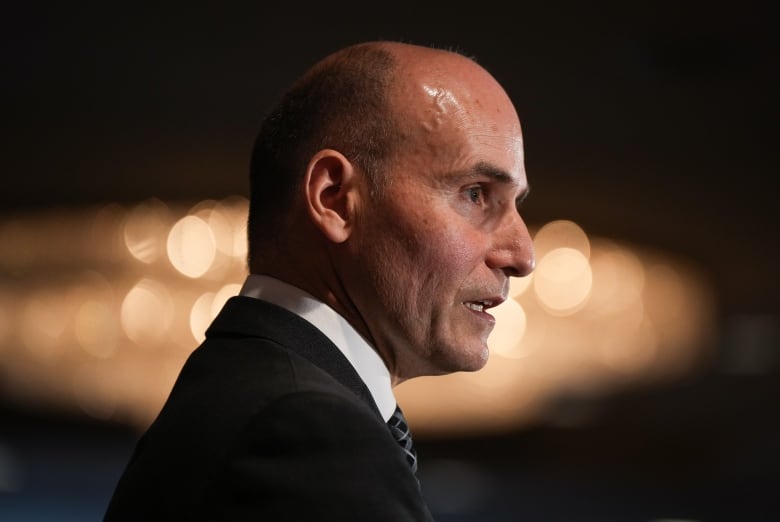
Federal Health Minister Jean-Yves Duclos said he is willing to bring more money into the system — but only if the provinces agree to system reforms to improve outcomes.
Doctors and administrators working in the health-care system say that reform is essential if any new money is going to improve delivery — and they have plenty of ideas about the changes that need to be made.
Relieving the administrative burden
The addition of administrative staff specifically tasked with non-medical responsibilities could help, but that won't happen without long-term, predictable funding that would come from a new health deal between the provinces and the federal government, Munter said.
"Five years ago we could put up a one-year contract, people would take it and then hope to be able to find a full-time job after. That's not possible anymore," he said. "We'll get zero applicants for those kinds of positions."
"We have to hire people permanently. And … a lot of the funding that comes and goes into the health system is temporary money."
An investment in community care, palliative care, home care would help alleviate strain on the hospitals.- OMA President Dr. Rose Zacharias
The federal government and the provinces have agreed to streamline how health information is shared in Canada, but doctors say that effort needs to speed up to take some of the administrative burden off doctors and nurses.
"Our digital integration is very poor," said Dr. Zacharias. "Doctors document inside software that doesn't communicate with hospital software, or pharmacist software, or COVID vaccination software.
"Doctors are spending a lot of time gathering the relevant data … and this is incredibly burdensome, and that burden has grown over time."
Experts say that while it takes years to reverse a shortage of doctors and nurses, quickly recognizing the foreign credentials of doctors and nurses already living in Canada would boost their numbers now without poaching health-care workers from abroad.
"We do have hundreds of doctors here in Ontario that have trained elsewhere that don't have a Canadian licence," said Dr. Zacharias. "If we were able to … put these physicians through those three months of a practice-ready assessment … we could see hundreds of doctors in the system by the spring."
Fixing the problem in the longer term is harder because it takes about five to 10 years to train a doctor in Canada. That timeline demands long-term, predictable funding, doctors say.
"We shouldn't be just thinking now. We should be thinking, okay, what's going to be our capacity need in 10 or 20 years? And we should be building now for 10 years from the future and in 10 years we should be planning for 10 years down the road again," said Freedman.
Changing how health care is delivered
The burden on the hospital system could be significantly reduced, doctors say, if more health care services were delivered outside of a hospital setting.
Increasing the delivery of non-hospital health services would require additional family doctors with lower administrative burdens. It also would require changes to how family practices work, doctors say.
"One [way] is to get doctors into teams of other allied health-care professionals, doctors working alongside nurse practitioners, physician assistants … psychotherapists, social workers, discharge coordinators, pharmacists [and] rehab therapists," said Dr. Zacharias.
"All of these allied health-care professionals on the team of a physician could really offload a lot of the responsibility that often patients look to the family doctor especially for."
Improved health care at the primary level, doctors say, would mean fewer people being sent to hospital because of the sheer volume of work family doctors do. The Alberta College of Family Physicians said that in 2020, 70 per cent of all health care visits in Canada were to a family doctor.
Doctors say that moving elective surgeries out of hospitals and into surgical centres would also help free up operating rooms for more urgent surgeries. They also say that moving palliative care out of the hospital setting would free up beds and staff.
"Hospitals are filled with people who no longer need acute hospital attention, but they're there because they can't be safely discharged into the community or a long term care or hospice bed," said Dr. Zacharias. "An investment in community care, palliative care, home care would help alleviate strain on the hospitals."
Solving Canada's health-care crisis, experts say, requires more than just money. It requires a new way of doing things.
"I don't feel like crisis management, cash influxes ... I mean, no one's going to turn that down, but I think the bigger picture is, we need to talk about what do we need for the future," said Freedman.
KYIV, Ukraine (AP) — Russia deployed multiple drones overnight to attack parts of Ukraine and dozens were shot down, Ukrainian officials said Monday, in a series of relentless attacks through the weekend that killed three civilians on New Year's Eve.
Kyiv Mayor Vitali Klitschko said that 40 drones “headed for Kyiv” overnight, according to air defense forces, and all of them were destroyed.
Klitschko said 22 drones were destroyed over Kyiv, three in the outlying Kyiv region and 15 over neighboring provinces.
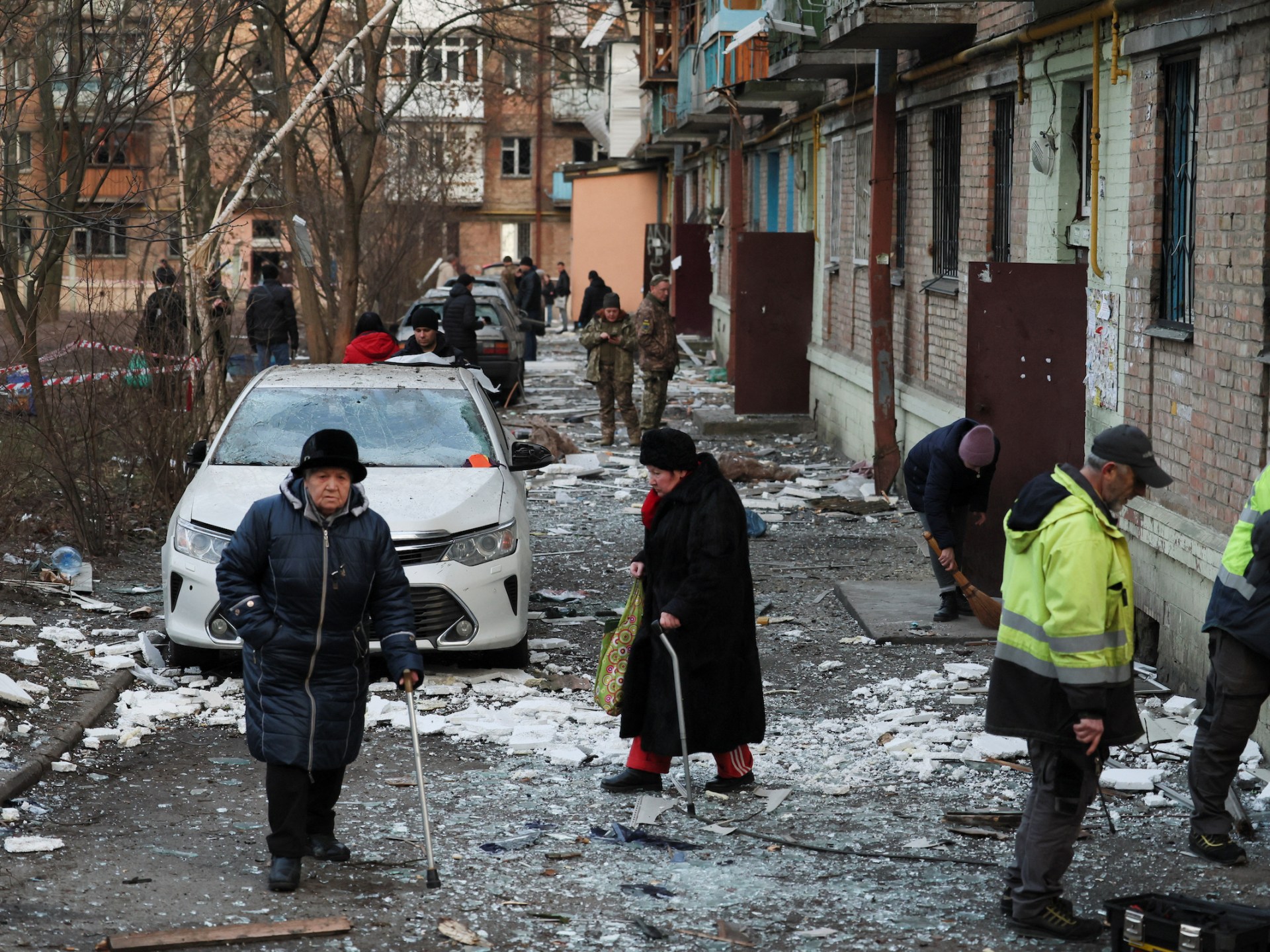
Energy infrastructure facilities were damaged as the result of the attack and an explosion occurred in one city district, the mayor said. It wasn’t immediately clear whether that was caused by drones or other munitions. A wounded 19-year-old man was hospitalized, Klitschko added, and emergency power outages were underway in the capital.
In the outlying Kyiv region a “critical infrastructure object” and residential buildings were hit, Gov. Oleksiy Kuleba said.
Seven drones were shot down over the southern Mykolaiv region, according to Gov. Vitali Kim, and three more were shot down in the southeastern Dnipropetrovsk region, Gov. Valentyn Reznichenko said.
In the Dnipropetrovsk region, a missile was also destroyed, according to Reznichenko. He said that energy infrastructure in the region was being targeted.
Ukraine's Air Force Command reported Monday that 39 Iranian-made exploding Shahed drones were shot down overnight, as well as two Russian-made Orlan drones and a X-59 missile across Ukraine.
A blistering New Year’s Eve assault killed at least four civilians across the country, Ukrainian authorities reported, and wounded dozens. The fourth victim, a 46-year-old resident of Kyiv, died in a hospital on Monday morning, Klitschko said.
Multiple blasts rocked the capital and other areas of Ukraine on Saturday and through the night. The strikes came 36 hours after widespread missile attacks Russia launched Thursday to damage energy infrastructure facilities, and the unusually quick follow-up alarmed Ukrainian officials.
Russia has carried out airstrikes on Ukrainian power and water supplies almost weekly since October, increasing the suffering of Ukrainians, while its ground forces struggle to hold ground and advance.
In Russia, a Ukrainian drone hit an energy facility in the Bryansk region that borders with Ukraine, Bryansk regional governor Alexander Bogomaz reported on Monday morning. A village was left without power as a result, he said.
Gunmen in armored vehicles attacked a state prison just across the border from El Paso early Sunday, killing 10 guards and four inmates, prosecutors said.
Various armed vehicles arrived at the state prison in Ciudad Juarez at about 7 a.m. and opened fire at guards, the Chihuahua state prosecutor’s office said in a statement.
Mexican soldiers stand guard outside a state prison in Ciudad Juarez, Mexico, Sunday Jan 1, 2023. Mexican soldiers and state police regained control of a state prison in Ciudad Juarez across the border from El Paso, Texas, after violence broke out early Sunday, according to state officials. (AP Photo/Christian Chavez)
Amid the chaos, an additional 13 people were wounded and at least 24 inmates escaped.
Mexican soldiers and state police regained control of the prison later Sunday. The state prosecutor's office said its personnel were investigating.
The state prison was the scene of a riot in August that spread to the streets of Juarez, resulting in nearly a dozen people dead.
In that case, two inmates were killed inside the prison and then alleged gang members started shooting up the town, including killing four employees of a radio station who were doing a promotion at a restaurant.
Mexican National Guard stand guard outside a state prison in Ciudad Juarez, Mexico, Sunday Jan 1, 2023. Mexican soldiers and state police regained control of a state prison in Ciudad Juarez across the border from El Paso, Texas after violence broke out early Sunday, according to state officials. (AP Photo/Christian Chavez)
Violence is frequent in Mexican prisons, including in some where authorities only maintain nominal control. Clashes regularly erupt among inmates in rival gangs, which in places like Juarez serve as proxies for drug cartels.
Shortly before Sunday's attack on the prison, municipal police were attacked and captured four men after a pursuit, according to the state prosecutor's office statement. Later, police killed two alleged gunmen traveling in an SUV.
The Associated Press contributed to this report.
Bradford Betz is a Fox News Digital breaking reporter covering crime, political issues, and much more.
While academics debate whether COVID-19 has transitioned to the endemic phase, it's safe to say most Manitobans have moved on from the pandemic.
Barriers to travel are gone. Workers are back in offices. Mask-wearing is optional in most public places.
After two and a half years, life is pretty much back to normal for the vast majority of people.
Yet one inconvenient statistic remains: More people died in 2022 either from COVID-19 or in association with the disease in this province than during each of the first two years of the pandemic.
As of Dec. 19, the last date for which any data is available, 2,350 Manitobans who contracted COVID-19 died from the virus or a related condition.
In 2020, 667 Manitobans died of COVID. That figure rose to 725 COVID fatalities in 2021.
And as of Dec. 19, 958 people in this province died from COVID or in connection with COVID, according to Manitoba Public Health.
Unusual situation
That creates the unusual situation where the deadliest year of the pandemic is also the year when most of us decided the pandemic was over.
"I think if you showed those statistics to the average Manitoban that they would be surprised," said Dr. Jillian Horton, a Health Sciences Centre internist and author who frequently comments on the pandemic. "I think most people on a multiple choice test would not correctly guess that more Manitobans have died this year of COVID than in the two prior years
"I think that most people on the street, if they don't have a reason to be following data and headlines very closely, would say, 'Yeah, the pandemic is over, it's not really a big deal any more,' but that certainly is not the reality for patients and it's not the reality inside our hospital."
For experts in public health and epidemiology, the increase in COVID deaths this year was no surprise. Thanks to more contagious SARS-Cov-2 variants such as Omicron and its subvariants, almost everyone got exposed to COVID in 2022, those experts believe.
Is the COVID-19 pandemic almost over?
4 days ago
Duration 1:34
Social behaviour is a big indicator of whether the COVID-19 pandemic is considered to be over, even if there are 30 deaths daily, says Dr. Samir Gupta, a Toronto respirologist.
That means the case-fatality rate for COVID — the proportion of people who died from the virus after contracting it — plummeted drastically this year.
The implication is the COVID we have right now in North America is far less severe than the virus that circulated in the fall of 2020, mainly because of widespread vaccinations.
The notion that the new variants are inherently less severe is still not settled science, says Dr. Jason Kindrachuk, the University of Manitoba medical microbiologust who became the province's best-known expert emerging pathogens during the pandemic.
"You can have viruses that have low casualty rates that still have big impacts if they are spreading broadly enough in the community," Kindrachuk said in an interview.
"We have to appreciate that even if this ends up being a true milder form of the disease, if it's spreading broadly enough in the population it can still have big impacts."
Kindrachuk, whose work is now focused more on monitoring the spread of Mpox, says the emergence of new coronavirus variants is all but inevitable. However, that is only a concern if one or more of those variants proves to be significantly more transmissable, more severe or more capable of evading immunity.
The dire situation unfolding in China, which recently relaxed brutal pandemic restrictions, may not have any bearing on COVID in North America, he says.
That's because China developed a different, less effective COVID-19 vaccine, compared with the very effective mRNA products deployed across most of the Western world. China also vaccinated a smaller proportion of its population.
"China may be very distinct from what we see in the rest of the world because of those other factors, so we need to be cautious," Kindrachuk said.
Greater danger
A greater danger in North America might be the absence of effective communication about keeping COVID at bay.
Canada has not done enough to promote the benefits of ventilating buildings, wearing masks and keeping up with vaccine boosters, Horton says.
"We actually get a really poor grade when it comes to our overall national effort to address the suffering and the death and the burden of illness that comes along with the disease," she said.
"People are really surprised when they hear things like COVID increases your risk of diabetes in the year after infection or the relationship between COVID and potential heart disease."
Mask-wearers in Mill Valley, California, 1918. Masking was widely used during the last global pandemic to mitigate the spread of influenza. (Raymond Coyne/Lucretia Little History Room, Mill Valley Public Library/Public domain)
It's unclear whether widespread changes are coming to building designs to ensure better ventilation as they did in the 1920s after the end of the 1918-2020 influenza epidemic.
Kindrachuk says he is not certain Canada is better prepared for the next pandemic, even after learning hard lessons over the past three years.
"The infrastructure doesn't get created overnight. The knowledge doesn't get created overnight. The dissemination of that knowledge certainly doesn't, either," he said.
"We need to make those moves forward and appreciate that in the interim we will continue to see new viruses and new infectious diseases that emerge or re-emerge and we are going to have to try and learn very quickly."
Ukraine’s President Volodymyr Zelenskyy said that his country will not forgive Russia and its aggression after Moscow fired 20 cruise missiles targeting Ukraine, including the capital Kyiv, on New Year’s Eve.
Russia on Saturday fired a barrage of missiles across Ukraine killing at least one person in the capital city in the second wave of attacks on the country in three days. On Friday, Russia carried out one of the largest air strikes since its invasion of Ukraine in February.
“Several waves of missile attacks on New Year’s Eve. Missiles against people … No one in the world will forgive you for this. Ukraine will not forgive,” Zelenskyy said on social media.
The explosions were reported throughout the country on New Year’s Eve on Saturday in attacks President Volodymyr Zelenskyy said showed Moscow was in league with the devil.
Zelenskyy, speaking in a video address, noted that Russia had also launched attacks at Easter and Christmas.
“They call themselves Christians … but they are for the devil. They are for him and with him,” he said.
The Ukrainian president in comments addressed to Russian speakers said President Vladimir Putin was destroying Russia’s future.
“No one will forgive you for terror. No one in the world will forgive you for this. Ukraine will not forgive,” he said, reiterating calls for allies to supply more anti-aircraft and anti-missile systems.
Kyiv Mayor Vitali Klitschko said at least one person had been killed and 20 wounded after a series of explosions in the capital.
The mayor said one of those injured was a Japanese journalist who had been taken to hospital.
A hotel just south of Kyiv’s city centre was hit, and a residential building in another district was damaged, according to the city administration.
Russia has claimed it was targeting infrastructure but Ukrainian officials say the latest assault targeted civilians.
Al Jazeera’s Charles Stratford, reporting from Kyiv, described a scene where experts gathered evidence of shrapnel, a pool of blood could be seen, and a two-metre crater was left by a direct hit on a neighbourhood in the capital.
“It’s an indication that this campaign by Vladimir Putin, by the Russians, targeting energy infrastructure goes on. [But] there is no indication of the infrastructure of any importance in this neighbourhood. A very grim scene here on New Year’s Eve.”
After the attack, Foreign Minister Dmytro Kuleba called for Russia to be deprived of its permanent seat on the United Nations Security Council.
“This time, Russia’s mass missile attack is deliberately targeting residential areas, not even our energy infrastructure,” Kuleba wrote on Twitter.
“War criminal Putin ‘celebrates’ New Year by killing people,” he said.
This time, Russia’s mass missile attack is deliberately targeting residential areas, not even our energy infrastructure. War criminal Putin “celebrates” New Year by killing people. Russia must be kicked out of its UN Security Council seat which it has always occupied illegally.
Other cities across Ukraine also came under fire. In the southern region of Mykolaiv, local governor Vitaliy Kim said on television that six people had been wounded.
In a separate post on Telegram, Kim said Russia had targeted civilians with the attacks, something Moscow has previously denied.
“According to today’s tendencies, the occupiers are striking, not just critical … in many cities [they are targeting] simply residential areas, hotels, garages, roads.”
In the western city of Khmelnytskyi, two people were wounded in a drone attack, Ukrainian presidential aide Kyrylo Tymoshenko said.
The official also reported an attack in the southern industrial powerhouse city of Zaporizhzhia, which Tymoshenko said had damaged residential buildings.
Ukraine’s defence ministry responded with a defiant message posted on Telegram.
“With each new missile attack on civilian infrastructure, more and more Ukrainians are convinced of the need to fight until the complete collapse of Putin’s regime,” he wrote.
Russia fighting to protect ‘motherland’
Meanwhile, President Vladimir Putin said Russia would never give in to the West’s attempts to use Ukraine as a tool to destroy his country.
In a New Year’s video message broadcast on state TV, Putin said Russia was fighting in Ukraine to protect its “motherland” and to secure “true independence” for its people.
Earlier, Russian defence minister Sergei Shoigu said his country’s victory in Ukraine was “inevitable” in a New Year’s message to servicemen, as Moscow’s military campaign grinds through its 11th month.
“In the coming year, I want to wish everyone good health, fortitude, reliable and devoted comrades … Our victory, like the New Year, is inevitable,” Shoigu said in the video address released by the defence ministry.
Shoigu said in the outgoing year “we all faced serious trials” and that the New Year comes during a “difficult military-political situation”. Russian troops have suffered a string of setbacks on the ground during the past months, with the Kremlin in September announcing the mobilisation of 300,000 reservists to join the fighting.