Rechercher dans ce blog

Sunday, June 4, 2023

India train crash kills more than 280, injures hundreds more - CBC News

Rescuers found no more survivors in the overturned and mangled wreckage of two passenger trains that derailed in eastern India, killing more than 280 people and injuring hundreds in one of the country's deadliest rail crashes in decades, officials said Saturday.

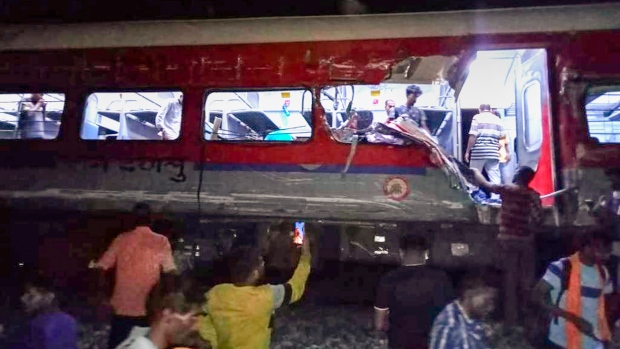
Chaotic scenes erupted after the derailment on Friday night about 220 kilometres southwest of Kolkata, as rescuers climbed atop the wrecked trains to break open doors and windows using cutting torches.

The death toll rose steadily throughout the night. Scores of bodies, covered by white sheets, lay on the ground near the tracks as locals and rescuers raced to help survivors. Army soldiers and air force helicopters joined the effort.

"By 10 p.m. (on Friday) we were able to rescue the survivors. After that it was about picking up dead bodies," Sudhanshu Sarangi, director of Odisha state's fire and emergency department, told The Associated Press. "This is very, very tragic. I have never seen anything like this in my career."

Dozens of people, many in safety orange, gather around mangled and askew railcars.
Rescue workers search for survivors at the accident site Saturday. (Dibyangshu Sarkar/AFP/Getty Images)

At least 280 bodies were recovered overnight and into Saturday morning, he said. About 900 people were injured and the cause was under investigation.

The accident occurred at a time when Prime Minister Narendra Modi is focusing on the modernization of the British colonial-era railroad network in India, which has become the world's most populous country with 1.42 billion people.

Despite government efforts to improve rail safety, several hundred accidents occur every year on India's railways, the largest train network under one management in the world.

Modi flew to the crash site and spent half an hour examining the relief effort and talking to rescue officials. He was seen giving instructions on the phone to officials in New Delhi.

He later visited a hospital where he walked around inquiring from doctors about the treatment being given to the injured, and spoke to some of them, moving from bed to bed in a ward.

Modi told reporters that it was a sad moment and he was feeling the pain of those who have suffered in the accident. He said the government would do its utmost to help them and strictly punish those found responsible.

Modi on Saturday was supposed to inaugurate a high-speed train connecting Goa and Mumbai that is equipped with a collision avoidance system. The event was cancelled after Friday's accident. The trains that derailed did not have that system.

Rescue work near completion

Amitabh Sharma, a Railroad Ministry spokesperson, said the rescue work was near completion. Rail authorities will start removing the wreckage to repair the track and resume train operations, he said.

About 200 of the severely injured people were transferred to specialty hospitals in other cities in Odisha, said P.K. Jena, the state's top administrative official. Another 200 were discharged after receiving medical care and the rest were being treated in local hospitals, he said. Scores of people also showed up to donate blood.

The wreckage of a train collision.
Rescuers work at the site where passenger trains derailed in the eastern Indian state of Odisha on Friday night. (Rafiq Maqbool/The Associated Press)

"The challenge now is identifying the bodies. Wherever the relatives are able to provide evidence, the bodies are handed over after autopsies. If not identified, maybe we have to go for a DNA test and other protocols," he said.

Accident involved 3 trains

Ten to 12 coaches of one train derailed, and debris from some of the mangled coaches fell onto a nearby track, said Sharma. The debris was hit by another passenger train coming from the opposite direction, causing up to three coaches of the second train to also derail, he added.

A grim-faced man is pictured among a crowd near several railcars.
India's Railways Minister Ashwini Vaishnaw arrives at the accident site Saturday. (AFP/Getty Images)

One of the trains also hit a freight train parked near Bahanaga Bazar station, leaving a tangled mess of smashed rail cars.

The rescue operation was slowed because two train cars were pressed together by the impact of the accident, Jena said.

1,200 rescuers

Officials said 1,200 rescuers worked with 115 ambulances, 50 buses and 45 mobile health units through the night. Saturday was declared as a day of mourning in Odisha.

Villagers said they rushed to the site to evacuate people after hearing a loud sound created by the train coaches going off the tracks.

"The local people really went out on a limb to help us. They not only helped in pulling out people, but retrieved our luggage and got us water," survivor Rupam Banerjee told the Press Trust of India.

WATCH | A survivor talks about his injuries in the crash:

Train crash in India kills hundreds, injures more

2 days ago

Duration 0:38

A survivor of the train crash said he ended up at the bottom of a pile of bodies after 10 to 15 people fell on top of him.

Passenger Vandana Kaleda said people were falling on each other as her coach shook violently and veered off the tracks.

"As I stepped out of the washroom, suddenly the train tilted. I lost my balance. Everything went topsy turvy. People started falling on each other and I was shocked and could not understand what happened. My mind stopped working," she said.

Another survivor who did not give his name said he was sleeping when the impact woke him up. He said he saw other passengers with broken limbs and disfigured faces.

The two moving trains were the Coromandel Express, travelling from Howrah in West Bengal state to Chennai in Tamil Nadu state, and the Howrah Superfast Express, travelling from Bengaluru in Karnataka to Howrah, officials said. It was not immediately clear which derailed first.

Opposition calls for railway minister to resign

Ashwini Vaishnaw, India's railway minister, said a high-level probe would be carried out. The political opposition criticized the government and called for Vaishnaw to resign.

In August 1995, two trains collided near New Delhi, killing 358 people in one of the worst train accidents in India.

In 2016, a passenger train slid off the tracks between the cities of Indore and Patna, killing 146 people.

Most train accidents are blamed on human error or outdated signalling equipment.

More than 12 million people ride 14,000 trains across India every day, travelling on 64,000 kilometres of track.

Adblock test (Why?)


India train crash kills more than 280, injures hundreds more - CBC News
Read More

Quebec bans access to more forests as fires burn - CBC.ca

Quebec's fire authority says it's unable to bring all 143 fires burning in the province under control. It says it can only attack between 20 to 30 fires at a time until reinforcement arrives.

"We took charge of 35 fires today, compared to 21 yesterday. We chose specific fires to protect our critical infrastructures, but above all to protect our population," said Public Security Minister François Bonnardel at a news conference Sunday.

"All our resources are concentrated on these fires." 

Armed forces and firefighters from outside the province started arriving Saturday to help local firefighters. About 100 soldiers are on the ground and 550 more firefighters are on the way. 

The backup should allow the provincial fire authority, the Société de protection des forêts contre le feu (SOPFEU), to change its strategy — which currently aims to protect cities and infrastructure — to go on the attack and put out the fires for good.

Forest access bans

Quebec's Forestry Ministry banned access to more forests and closed roads as of 8 a.m. Sunday as fires continue to burn across the province.

Access to forests in northern Quebec, Côte-Nord, Saguenay-Lac-Saint-Jean, Abitibi-Témiscamingue, Mauricie, Outaouais, Lanaudière and the Laurentians are limited. A list of closed parks and forests is available on the government's website.

The ministry says it is necessary to restrict access to forests to lower the risk of new fires and to help make firefighting operations easier.

The risk of new forest fires is also prompting the agency that manages Quebec's provincial parks network, the Société des établissements de plein air du Québec (SEPAQ), to ban or limit access to 13 of its parks. They include the La Vérendrye and the Laurentides wildlife reserves, and a full list of closed parks is available.

State of emergency

Val d'Or and a nearby town in Abitibi-Ouest are the latest municipalities to proceed with evacuations because of the forest fires. Val d'Or has declared a state of emergency.

The city issued an evacuation order for people living in the sectors of Louvicourt, Lac Wyeth, Lac Guéguen, Lac Matchi-Manitou and Lac Villebon, "given that two out-of-control fires are raging on the east side of the Louvicourt sector and due to poor air quality," it said in a news release.

Evacuees can head over to the Fournier Multisport Center, which is also sheltering people from the Anishinaabe Nation of Lac Simon and the Algonquin community of Kiticisakik forced to leave their homes Saturday.

Those in Val d'Or's urban core are not affected by the evacuation notice as fires don't threaten the area, though the air quality is still considered very bad and residents are encouraged to stay indoors.

a road with a sign reading "Rivière-Héva" with smoke in the air
Heavy smoke from forest fires hangs in the air on Route 117 toward Val d'Or, Que. ( Boualem Hadjouti/Radio-Canada)

The town of Normétal in Abitibi-Ouest is also under an evacuation order. Officials redirected the 754 residents south of the town to either Dupuy or La Sarre.

In total, about 14,000 people have been forced to leave their homes in communities near forest fires, including Sept-Îles on Quebec's North Shore, the neighbouring Innu community of Mani-Utenam and Lebel-sur-Quévillon in Northern Quebec.

The city of Sept-Îles has renewed a local state of emergency for five days, but no new evacuations will take place Sunday.

Evacuation notices for the Moisie, Les Plages and Lac Daigle sectors will be maintained for at least another 24 hours. 

Mayor of Sept-Îles Steeve Beaupré says he doesn't want people to return to their homes and have to be evacuated again. But, he is optimistic on the evolution of fires by Nipissis River as they are slowing down.

Though temperatures are cooler, a change of winds and having less rain than expected in the forecast at the beginning of the week is causing concern, he said.

Hospitalizations, air evacuations 

Manon Asselin, the general director of the CISSS Côte-Nord, said 47 people needed acute care and were transported to hospitals in Montreal and Quebec City by air evacuation. 

No more air evacuations are planned and authorities say they are preparing to evacuate patients by road if needed. 

Adblock test (Why?)


Quebec bans access to more forests as fires burn - CBC.ca
Read More

I see more cars on dealer lots. Does that mean shortages are over? - The Globe and Mail

I’m noticing a few more new cars on dealer lots than before, although they’re still not anywhere close to full. Does that mean no more waits and lower prices than we’ve been seeing? – Tim, Winnipeg

While most dealer lots are less barren than a year ago, we’re not quite back to normal, dealers said in a survey.

That means you should expect high prices and long waits for a while yet.

“[The recovery] is uneven and unequal. Some models have recovered in inventory while others have not,” said Andrew King, managing partner of DesRosiers Automotive Consultants, an automotive market research firm based in Richmond Hill, Ont. “Transaction prices have certainly increased.”

For more than two years, a global shortage of semiconductor chips, worsened by material shortages, increased demand for electronics during lockdowns and supply chain disruptions owing to the pandemic, has slowed new car production.

In the first quarter of 2023, dealer inventories, nationally, were at about 42 per cent of their 2019 levels, according to a survey of dealers by DesRosiers and the Canadian Automobile Dealers Association (CADA).

However, that’s more than twice as many cars on dealer lots as this time last year – at the time, it was 19.4 per cent of normal, King said. There’s still a shortage of some high-demand models, including certain trucks and SUVs.

The supply also varies by region, with more populated regions getting more cars. In the first quarter of 2023, Manitoba and Saskatchewan had about 30 per cent of the new vehicle inventory they had in 2019 – with an average of 43 new vehicles per dealer lot compared to 141 per lot in 2019.

Nearly half of dealers said they don’t expect the supply of new vehicles to significantly improve until next year.

Prices keep climbing

Average new vehicle prices have been steadily increasing because of inventory shortages, inflation and growing consumer preference for SUVs over less expensive sedans, King said.

SUVs and trucks – which accounted for nearly 84 per cent of all new vehicles sold in Canada last year – have seen the biggest price increase. Last year, the average price of SUVs and trucks was nearly $52,000 – almost $5,000 more than the year before.

Also, as more buyers looked for used cars because new cars weren’t immediately available, used car prices rose by 40 per cent, on average. While used car prices have dropped somewhat because of slowing demand, they’re still higher than normal, an industry analyst said.

“For six to eight months of time now, the [used] market has slowed down, but we’re still 20 per cent over [2019] prices,” said Daniel Ross, senior manager for industry insights with Canadian Black Book (CBB), a Markham, Ont.-based company that tracks and forecasts used-vehicle prices. “[Still], in some cases, used cars are more expensive than new cars.”

In an Ipsos survey conducted for CBB in March, six in 10 Canadians surveyed said they’ll hold off on purchasing a car because prices are so high now.

While customer demand for new and used vehicles has slowed as rising interest rates have made it more expensive to finance a car purchase, Ross said he doesn’t expect a significant drop in prices any time soon.

“This is a typical time of the year for people to start shopping for cars,” Ross said. “So prices are stabilizing [instead of dropping further].”

Have a driving question? Send it to globedrive@globeandmail.com and put ‘Driving Concerns’ in your subject line. Emails without the correct subject line may not be answered. Canada’s a big place, so let us know where you are so we can find the answer for your city and province.

Adblock test (Why?)


I see more cars on dealer lots. Does that mean shortages are over? - The Globe and Mail
Read More

Saturday, June 3, 2023

India train crash: More than 260 dead after Odisha accident - BBC

This video can not be played

To play this video you need to enable JavaScript in your browser.

At least 261 people have been killed and 1,000 are injured in a crash involving three trains in India's eastern Odisha state.

One passenger train derailed on to the adjacent track and was struck by an incoming train on Friday, also hitting a nearby stationary freight train.

A massive recovery operation is under way, after hundreds of emergency workers searched the wreckage.

The cause of India's worst train crash in over 20 years is not yet clear.

Officials say several carriages from the Coromandel Express, travelling between Kolkata (formerly Calcutta) and Chennai (formerly Madras), derailed at about 19:00 (13:30 GMT) in Balasore district after hitting a stationary goods train. Several of its coaches ended up on the opposite track.

Another train travelling in the opposite direction - the Howrah Superfast Express travelling from Yesvantpur to Howrah - then hit the overturned carriages.

"The force with which the trains collided has resulted in several coaches being crushed and mangled," Atul Karwal, chief of the National Disaster Response Force (NDRF) told ANI news agency.

More than 200 ambulances and hundreds of doctors, nurses and rescue personnel were sent to the scene, the state's chief secretary Pradeep Jena said.

Sudhanshu Sarangi, director general of Odisha Fire Services, had earlier said 288 had died.

All trapped and injured passengers have been rescued. It is not clear how serious the injuries of those taken to hospitals were.

Work to restore the site of the crash begun, India's South Eastern Railway company said on Saturday.

Rescuers searching the wreckage for survivors
EPA

Prime Minister Narendra Modi visited the site of the accident on Saturday afternoon, joining Railway Minister Ashwini Vaishnaw at the scene.

An investigation into the cause of the crash has been launched, although Education Minister Dharmendra Pradhan has blamed "technical reasons".

Survivors and eyewitnesses have described chaotic scenes and the heroic efforts of people from nearby villages to save trapped passengers.

Mukesh Pandit, who was trapped for half an hour before being rescued, told the BBC he heard a "thunderous sound" shortly before the carriage overturned.

"Four passengers who were travelling from my village have survived, but a lot of people are injured or still missing. A lot of people died in the coach I was travelling in," he added.

Site of the crash
Presentational grey line

India's deadly train crashes

  • June 1981: Nearly 800 people died when seven of the nine coaches of an overcrowded train fell into a river during a cyclone
  • August 1995: At least 350 people are killed when two trains collide 200km (125 miles) from Delhi
  • August 1999: Two trains collide near Kolkata killing at least 285 people
  • October 2005: 77 people are killed when a train derails in the southern state of Andhra Pradesh
  • November 2016: Nearly 150 people are killed and an equal number are injured when 14 carriages of the Indore-Patna Express train derail near the city of Kanpur
Presentational grey line

Residents of the neighbouring villages were among the first to reach the site of the accident and start the rescue operation.

India has one of the largest train networks in the world with millions of passengers using it daily, but a lot of the railway infrastructure needs improving.

Trains can get very packed at this time of year, with a growing number of people travelling during school holidays.

Both passenger trains involved in the crash were full and had many more people on the waiting list, according to passenger lists on the Indian rail ministry website reviewed by the BBC.

India's worst train disaster was in 1981, when an overcrowded passenger train was blown off the tracks and into a river during a cyclone in Bihar state, killing at least 800 people.

Banner saying 'Get in touch'

Are you in the area? Did you witness the incident? Email haveyoursay@bbc.co.uk.

Please include a contact number if you are willing to speak to a BBC journalist. You can also get in touch in the following ways:

If you are reading this page and can't see the form you will need to visit the mobile version of the BBC website to submit your question or comment or you can email us at HaveYourSay@bbc.co.uk. Please include your name, age and location with any submission.

Related Topics

Adblock test (Why?)


India train crash: More than 260 dead after Odisha accident - BBC
Read More

India train derailment: more than 200 people killed, 900 injured - CP24


Ashok Sharma, The Associated Press
Published Friday, June 2, 2023 3:19PM EDT
Last Updated Friday, June 2, 2023 10:12PM EDT

NEW DELHI (AP) - Two passenger trains derailed Friday in India, killing more than 200 people and trapping hundreds of others inside more than a dozen damaged rail cars, officials said.

The accident that happened about 220 kilometers (137 miles) southwest of Kolkata created a chaotic scene of twisted wreckage and desperate rescuers as teams tried to free passengers and recover bodies. The cause was under investigation.

About 900 people were injured in the accident, P.K. Jena, the top bureaucrat in the eastern state of Odisha, said in a tweet.

Ten to 12 coaches of one train derailed, and debris from some of the mangled coaches fell onto a nearby track, said Amitabh Sharma, a railroad ministry spokesperson.

The debris was hit by another passenger train coming from the opposite direction, and up to three coaches of the second train also derailed, Sharma said.

The Press Trust reported that a third train carrying freight was also involved, but there was no immediate confirmation from railroad authorities. The Press Trust report said some of the derailed passenger coaches hit cars from the freight train.

The death toll rose steadily throughout the night. As dawn approached on Saturday, Jena said that at least 233 people were dead.

In the aftermath, television images showed rescuers climbing atop the wreckage to break open doors and windows and using cutting torches to free survivors.

Officials said 1,200 rescuers worked with 115 ambulances, 50 buses and 45 mobile health units through the night at the accident site.

Villagers said they rushed to the site to evacuate people after hearing a loud sound created by the train coaches going off the tracks.

“The local people really went out on a limb to help us. They not only helped in pulling out people, but retrieved our luggage and got us water,” PTI cited Rupam Banerjee, a survivor, as saying.

Passenger Vandana Kaleda said that she “found people falling on each other” as her coach shook violently and veered off the tracks.

“As I stepped out of the washroom, suddenly the train tilted. I lost my balance. ... Everything went topsy turvy. People started falling on each other and I was shocked and could not understand what happened. My mind stopped working,” she said, adding she was lucky to survive.

Another survivor who did not give his name said he was sleeping when the impact woke him up. He said he saw other passengers with broken limbs and disfigured faces.

The Press Trust said the derailed Coromandel Express was traveling from Howrah in West Bengal state to Chennai, the capital of southern Tamil Nadu state.

Indian Prime Minister Narendra Modi said his thoughts were with the bereaved families.

“May the injured recover soon,” tweeted Modi, who said he had spoken to the railway minister and that “all possible assistance” was being offered.

Officials announced a day of mourning on Saturday in the state.

Despite government efforts to improve rail safety, several hundred accidents occur every year on India's railways, the largest train network under one management in the world.

In August 1995, two trains collided near New Delhi, killing 358 people in one of the worst train accidents in India's history.

In 2016, a passenger train slid off the tracks between the cities of Indore and Patna, killing 146 people.

Most train accidents are blamed on human error or outdated signaling equipment.

More than 12 million people ride 14,000 trains across India every day, traveling on 64,000 kilometers (40,000 miles) of track.

Adblock test (Why?)


India train derailment: more than 200 people killed, 900 injured - CP24
Read More

More than 5000 new species discovered at future deep-sea mining site in Pacific Ocean - CTV News

More than 5,000 new species have been discovered at an expansive future deep-sea mining site in the Pacific Ocean.

Known as the Clarion-Clipperton Zone (CCZ), the mineral-rich site stretches six million square kilometers from Mexico to Hawaii. About twice the size of India, the CCZ has already been carved up into mining claims for future exploitation, with companies eager to harvest abundant deposits of key battery materials like manganese and cobalt that are located 4,000 to 6,000 metres below the surface.

To better understand what could be at risk once mining begins, a team of biologists led by London's Natural History Museum sought to survey the region's biodiversity. Of the 5,578 species they identified, approximately 90 per cent were entirely new to science.

"We share this planet with all this amazing biodiversity, and we have a responsibility to understand it and protect it," lead author and Natural History Museum deep-sea ecologist Muriel Rabone said in a news release last week. "There are so many wonderful species in the CCZ, and with the possibility of mining looming, it’s doubly important that we know more about these really understudied habitats."

The team compiled a list of all species found in previous studies of the region, and also embarked on their own research expeditions to survey the ocean floor. Using techniques like remote-controlled vehicles and box core sampling, which is basically a box that scoops up material from the seafloor, they collected over 100,000 records of creatures of the deep from this largely untouched underwater wilderness.

“It's a big boat, but it feels tiny in the middle of the ocean,” Rabone said of the research cruises. “And it was amazing—in every single box core sample, we would see new species.”

The most common types of animals were arthropods like worms and sponges. Newly discovered species included what's known as the "gummy squirrel," a gelatinous-looking sea cucumber with a large tail-like protrusion. Only six species have been seen elsewhere in the ocean.

"Some of the sponges look like classic bath sponges, and some look like vases. They’re just beautiful," Rabone said. "One of my favorites is the glass sponges. They have these little spines, and under the microscope, they look like tiny chandeliers or little sculptures."

The peer-reviewed study, which includes images, was published in the journal Current Biology last week.

The UN-affiliated International Seabed Authority, which was created to regulate mining in international waters, begins accepting applications to exploit the CCZ in July. Commercial deep-sea mining, which is still in an exploratory phase, would collect potato-sized deposits known as "polymetallic nodules" that can be found on and just under the region's seabed.

"There are so many wonderful species in the CCZ, and with the possibility of mining looming, it’s doubly important that we know more about these really understudied habitats," Rabone said.

While companies and countries like China and the U.S. pursue deep-sea mining, others like France, Chile and Canada have called for moratoriums or bans in their waters over environmental concerns.

With files from Reuters

Adblock test (Why?)


More than 5000 new species discovered at future deep-sea mining site in Pacific Ocean - CTV News
Read More

India train crash: More than 260 dead after Odisha accident - BBC

This video can not be played

To play this video you need to enable JavaScript in your browser.

At least 261 people have been killed and 1,000 are injured in a crash involving three trains in India's eastern Odisha state.

One passenger train derailed on to the adjacent track and was struck by an incoming train on Friday, also hitting a nearby stationary freight train.

A massive recovery operation is under way, after hundreds of emergency workers searched the wreckage.

The cause of India's worst train crash in over 20 years is not yet clear.

Officials say several carriages from the Coromandel Express, travelling between Kolkata (formerly Calcutta) and Chennai (formerly Madras), derailed at about 19:00 (13:30 GMT) in Balasore district after hitting a stationary goods train. Several of its coaches ended up on the opposite track.

Another train travelling in the opposite direction - the Howrah Superfast Express travelling from Yesvantpur to Howrah - then hit the overturned carriages.

"The force with which the trains collided has resulted in several coaches being crushed and mangled," Atul Karwal, chief of the National Disaster Response Force (NDRF) told ANI news agency.

More than 200 ambulances and hundreds of doctors, nurses and rescue personnel were sent to the scene, the state's chief secretary Pradeep Jena said.

Sudhanshu Sarangi, director general of Odisha Fire Services, had earlier said 288 had died.

All trapped and injured passengers have been rescued. It is not clear how serious the injuries of those taken to hospitals were.

Work to restore the site of the crash begun, India's South Eastern Railway company said on Saturday.

Rescuers searching the wreckage for survivors
EPA

Prime Minister Narendra Modi visited the site of the accident on Saturday afternoon, joining Railway Minister Ashwini Vaishnaw at the scene.

An investigation into the cause of the crash has been launched, although Education Minister Dharmendra Pradhan has blamed "technical reasons".

Survivors and eyewitnesses have described chaotic scenes and the heroic efforts of people from nearby villages to save trapped passengers.

Mukesh Pandit, who was trapped for half an hour before being rescued, told the BBC he heard a "thunderous sound" shortly before the carriage overturned.

"Four passengers who were travelling from my village have survived, but a lot of people are injured or still missing. A lot of people died in the coach I was travelling in," he added.

Site of the crash
Presentational grey line

India's deadly train crashes

  • June 1981: Nearly 800 people died when seven of the nine coaches of an overcrowded train fell into a river during a cyclone
  • August 1995: At least 350 people are killed when two trains collide 200km (125 miles) from Delhi
  • August 1999: Two trains collide near Kolkata killing at least 285 people
  • October 2005: 77 people are killed when a train derails in the southern state of Andhra Pradesh
  • November 2016: Nearly 150 people are killed and an equal number are injured when 14 carriages of the Indore-Patna Express train derail near the city of Kanpur
Presentational grey line

Residents of the neighbouring villages were among the first to reach the site of the accident and start the rescue operation.

India has one of the largest train networks in the world with millions of passengers using it daily, but a lot of the railway infrastructure needs improving.

Trains can get very packed at this time of year, with a growing number of people travelling during school holidays.

Both passenger trains involved in the crash were full and had many more people on the waiting list, according to passenger lists on the Indian rail ministry website reviewed by the BBC.

India's worst train disaster was in 1981, when an overcrowded passenger train was blown off the tracks and into a river during a cyclone in Bihar state, killing at least 800 people.

Banner saying 'Get in touch'

Are you in the area? Did you witness the incident? Email haveyoursay@bbc.co.uk.

Please include a contact number if you are willing to speak to a BBC journalist. You can also get in touch in the following ways:

If you are reading this page and can't see the form you will need to visit the mobile version of the BBC website to submit your question or comment or you can email us at HaveYourSay@bbc.co.uk. Please include your name, age and location with any submission.

Related Topics

Adblock test (Why?)


India train crash: More than 260 dead after Odisha accident - BBC
Read More

Lupus and other autoimmune diseases strike far more women than men. Now there's a clue why - CTV News

WASHINGTON - Women are far more likely than men to get autoimmune diseases, when an out-of-whack immune system attacks their own bodies -...