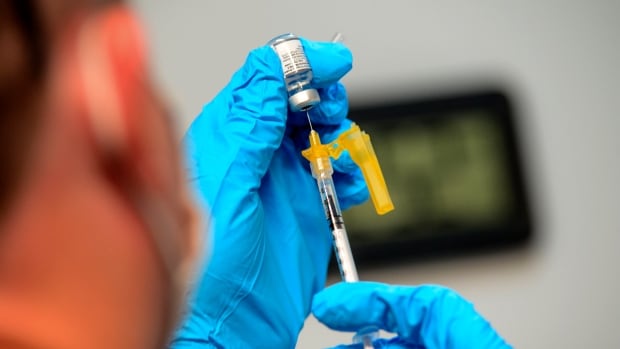
More than 1,000 New Brunswickers have had an adverse reaction after getting a COVID-19 vaccine, and more than a quarter of them were considered "serious," according to the Department of Health.
A total of more than two million vaccines have been administered in the province, putting the incidence at roughly 0.06 per cent.
Spokesperson Adam Bowie did not provide any information about the nature of the reactions, but the Public Health Agency of Canada defines an adverse event as "any untoward medical occurrence which follows immunization." It isn't necessarily causally related to the vaccine.
The adverse event may be any:
Unfavourable or unintended sign (for example: skin rash).
Abnormal laboratory finding.
Symptom.
Disease.
An event is considered serious if it:
Results in death.
Is life-threatening, such as anaphylaxis, a severe allergic reaction.
Requires in-patient hospitalization or prolongation of existing hospitalization.
Results in persistent or significant disability/incapacity.
Results in a congenital anomaly/birth defect.
Bowie did not provide a breakdown of reactions by type of vaccine or by ages, either.
Earlier this month, the Centers for Disease Control and Prevention (CDC) and the U.S. Food and Drug Administration (FDA) reported a possible link between ischemic strokes in people aged 65 and older and the Pfizer-BioNTech COVID-19 bivalent vaccine, which is designed to target the Omicron subvariants BA.4 and BA.5.
An ischemic stroke occurs when blood flow to the brain is interrupted or reduced by a blockage or clot. This prevents the brain tissue from getting the oxygen and nutrients it needs to survive.
"Although the totality of the data currently suggests that it is very unlikely that the signal in VSD [vaccine safety datalink] represents a true clinical risk, we believe it is important to share this information with the public," the U.S. health officials had said.
Monitoring the situation closely
New Brunswick Public Health, the Public Health Agency of Canada and Health Canada are all aware of the U.S. report, issued on Jan. 13, based on their vaccine adverse event reporting surveillance system, said Bowie.
"So far, these safety concerns have not been raised through other vaccine safety monitoring systems in the United States, or in other countries — including Canada," he said in an emailed statement.
"It should be noted the CDC did not recommend any changes to vaccination practices at this time, and that these adverse events have not yet been confirmed to have been caused by the vaccines administered.
If New Brunswick Public Health's recommendations regarding the safety or suitability of this vaccine were to change, that information would be communicated to the public.- Adam Bowie, Department of Health spokesperson
"Additional analysis and reviews must be completed to further explore the causes of these reactions and that data is used as part of the continuous monitoring of the safety of these vaccines."
Still, New Brunswick and federal health officials are "monitoring this situation closely," said Bowie.
"If New Brunswick Public Health's recommendations regarding the safety or suitability of this vaccine were to change, that information would be communicated to the public," he said.
'Less than five' strokes after bivalent reported in Canada
As of Jan. 1, more than seven million doses of mRNA bivalent vaccines have been administered in Canada, and the Public Health Agency of Canada and Health Canada say they've not observed any elevated risks or safety signals for thromboembolic or vascular events following the administration of these vaccines, noted Bowie.
"Less than five" reports of ischemic stroke following the administration of an mRNA bivalent vaccine have been submitted to the federal bodies to date, he said. Only one of these involved a Pfizer-BioNTech bivalent vaccine for a person aged 65 years or older.
In New Brunswick, 1,148 adverse events related to COVID-19 vaccines have been reported to the Department of Health, from the 2,028,684 total doses administered between Dec. 14, 2020, and Jan. 14, 2023, said Bowie.
"Of those, 313 events were labelled serious in nature," he said.
Benefits continue to outweigh risks
"Evidence indicates that the benefits of COVID-19 vaccines continue to outweigh the risks of the disease," the federal website states.
Across Canada, of the 96,432,067 COVID-19 vaccines administered to date, adverse events have been reported by 53,611 people. That's about six people out of every 10,000 people vaccinated who have reported one or more adverse events.
Of those, 10,565 adverse events were considered serious in nature, an incidence of 0.01 per cent.
"Citizens should be aware that vaccine providers are legally required to report any adverse events in New Brunswick under the Public Health Act, and immunization data is regularly monitored to ensure that any unusual safety trends would be identified quickly," said Bowie.
Federal health officials also review data from provinces and territories across the country to identify any new or emerging trends, he said.
More visible signs of war are emerging in Russia, with air defences being placed on Moscow rooftops and Kremlin officials sharply decrying the widening array of weapons the West is providing to Ukraine.
Reports emerged on social media last week that anti-aircraft missiles had been spotted on key buildings in central Moscow, including at a defence ministry command centre. Military drills also took place outside the capital, with Russia's defence ministry saying troops "conducted an exercise to repel a mock air attack."
There is nothing abnormal about countries having air defences around key military installations or major cities. But new military drills testing S-300 mobile surface-to-air batteries around the capital, coupled with social media reports that Pantsir S-1 anti-aircraft missiles had been mounted on buildings in central Moscow, suggest Russia may be reinforcing its air defences.
These developments have occurred alongside growing tensions about tanks and other heavy weapons that Ukraine has been promised by Western allies, leaving Russia weighing their implications for the conflict.
WATCH | Will Western-sourced tanks make a difference in Ukraine?
Why new tanks for Ukraine could create a turning point in the war
3 days ago
Duration 2:43
Breaking down what makes the tanks announced for Ukraine so significant in terms of their military force, and what kind of difference they could make in the war.
With arms shipments intensifying, some Russia watchers say there could be real concerns within parts of Russia's defence establishment about the potential for the war to heat up closer to home.
Oleg Ignatov, a senior Russia analyst for the International Crisis Group, a non-governmental organization, believes a decision to erect these defences stems from concerns that Moscow should be prepared for the unexpected.
"It seems that [the] Ukrainians have capabilities that allow them to strike deep inside Russia," Ignatov told CBC News from Brussels, pointing to high-profile attacks in Russian-held Crimea and on targets inside Russia.
Ignatov believes Russia is unclear how far Kyiv's reach may extend, as billions of dollars worth of advanced Western military aid pours into the country.
Dani Nedal, an assistant professor of political science at the University of Toronto, said the West has grown willing to arm Ukraine with more sophisticated weapons, despite initial hesitations.
"The restraint has been eroded over time," said Nedal, noting the West's shift from an earlier position of providing Ukraine with primarily defensive weapons.
Kremlin spokesperson Dmitry Peskov said Thursday that Moscow views recently announced tank shipments and other aid as part of the West's "growing" and "direct involvement in the conflict."
'Very focused' deployment
While people living in Moscow may be watching what's happening with new air defences, Ignatov does not think domestic considerations are driving the deployment.
"They didn't put [them] everywhere," he said. "It's not massive, it's very focused."
A man walks past an inscription reading 'No to war' left on a wall in Moscow on Jan. 26. (Natalia Kolesnikova/AFP/Getty Images)
Nedal said these deployments can't be done in secret. And he believes the Russian government has downplayed its significance.
"If you're the Russian government, you won't wait until there is an attack to start placing air defences," he said.
But Dan Storyev, the English-language managing editor of OVD-Info, an independent human rights group that monitors protests in Russia, is more skeptical on the domestic political motives driving new air defences.
"In my opinion, there is little hard military rationale to deploy [these] in Moscow in such a manner," Storyev said via email, speaking as an individual and not on behalf of his organization.
Storyev said the move might "reassure Muscovites of their safety, but it will simultaneously function as a reminder of war."
Analysts at the Institute for the Study of War had a similar take, recently surmising the Kremlin deployed them "to generate inflammatory images that portray the war as more threatening to the Russian public."
Pedestrians' shadows are highlighted against the wall of an underpass near Moscow's Red Square, at sunset, earlier this month. (Alexander Zemlianichenko/The Associated Press)
Emily Harding, deputy director and senior fellow with the International Security Program at the Center for Strategic and Intelligence Studies in Washington, said the air defences could be part of a larger message Russia has presented about the war itself.
"They've been spinning this conflict, from the beginning, as a defensive action by them, as opposed to an offensive action," said Harding, who investigated Russian interference in the 2016 U.S. election, while previously working for the U.S. Senate Select Committee on Intelligence.
"They've been telling themselves and their people that this was designed to be defending Russia against NATO's encroachment."
A man in Kyiv takes a selfie in front of giant mock-up of a postal stamp depicting a burning Kremlin building in Moscow, earlier this month. (Valentyn Ogirenko/Reuters)
If Russia pushes forward with a new offensive, that could provide an impetus for it tighten up its own defences — as it may be doing in Moscow. "If they are preparing for a new offensive, of course they should care about defence of their critical objects," Ignatov said.
Harding, however, said a Ukrainian attack on Moscow seems neither likely nor planned.
"It seems like every time the conflict looks like it could escalate, the parties sort of bring it back to the interior of Ukraine," she said.
"And I think it behooves everybody in the conflict to keep it limited. Russia doesn't want a wider war. NATO certainly doesn't want a wider war."
A Ukrainian tank fires toward a Russian position near the town of Bakhmut, Ukraine on Thursday, as the conflict nears its one-year anniversary. (Anatolii Stepanov/AFP/Getty Images)
CEO of Porter Airlines Michael Deluce with the Embraer E195-E2 before its inaugural flight from Pearson Airport during a flight preview in Toronto, on Jan. 27.Christopher Katsarov/The Globe and Mail
Porter Airlines is aiming to shoulder its way out of the pandemic with a billion-dollar bet on dozens of bigger planes and new routes in a pivotal year for the Canadian air travel industry.
The first of Porter’s 132-seat Embraer jets begins flying customers to Ottawa and Montreal from the airline’s new hub at Toronto Pearson International Airport on Feb. 1.
Porter’s expanded fleet, and the shift to Canada’s busiest airport, marks a new strategy for the airline founded by pilot Robert Deluce 17 years ago, placing it in direct competition with Air Canada and WestJet Airlines. But it’s just one of several discount carriers offering cheap seats in an attempt to gain a toehold in the domestic market.
Chris Murray, an analyst at ATB Financial, says 2023 will be one of the most interesting years in Canadian aviation history. “Everyone’s got these big plans.”
Mr. Murray pointed to improved financial results at U.S. airlines, which are usually six months ahead of their Canadian counterparts, and strong demand for aircraft at Boeing and Airbus. “What we’ve seen in the airline industry is when travel comes back, it comes back viciously. There’s tremendous pent-up demand.”
While customers are eager to leave COVID-19 behind, airlines and airports have so far limped rather than soared out of the pandemic wreckage, bungling summer and Christmas restarts.
Mainstays Air Canada and WestJet will attempt to stabilize their businesses as they revamp routes and fleets amid new competition from cheaper rivals Lynx, Canada Jetlines and Flair Airlines. Air Transat hopes a rebound in vacation demand will stanch its losses and cut its dependence on government bailouts. Sunwing Airlines, whose holiday blunders drew the ire of politicians and stranded passengers, will attempt to sew up its takeover by WestJet and assuage regulators’ concerns.
And then there’s Porter, shifting its focus to bigger aircraft and new markets with its jet-powered expansion beyond Toronto’s smaller Billy Bishop Toronto City Airport, the hub for its short-range 78-seat De Havilland Dash 8 turboprop planes.
“Talk about crowded skies,” said Barry Prentice, a professor at University of Manitoba.
Can the Canadian market support so many airlines? “The answer is no,” he said.
“Of course not,” said John Gradek, who teaches aviation leadership at McGill University. “My guess is we’ll probably lose a carrier by the end of the year. Not sure which one.”
Mr. Deluce, Porter’s founder, flew into Pearson from Brazil late December on the company’s first Embraer jet. “This is a significant milestone,” he said on Friday at a preview flight of the plane, painted in Porter’s familiar white with a blue logo-covered tail.
Robert’s son Michael Deluce, Porter’s chief executive officer, said the airline is targeting economy travellers, who constitute 90 per cent of the market.
Porter has been competing with Air Canada since Day 1, he said, and is marketing heavily on WestJet’s Western turf to boost business there. He said Porter’s prospects are helped by WestJet’s recent pullback from Eastern Canada.
Porter’s new fleet will initially work the routes between Toronto, Ottawa, Halifax, Montreal, Edmonton and Calgary before expanding to other North American and Caribbean destinations. Previously, the airline was limited to the 2,040-kilometre range of its Dash 8s.
Porter will fly from Toronto Pearson’s Terminal 3, which is also used by WestJet. “They’re going to be trying to steal WestJet’s business, more so than Air Canada’s,” said Mr. Gradek, predicting the two main carriers will slash prices in response.
Porter says its single-aisle planes will appeal to customers because there are no middle seats, and passengers get free drinks and snacks. The airline’s E195 orders total 100, including 50 firm orders and 50 purchase rights for a value that exceeds US$7-billion at list prices. It has five of the new planes already and expects another 25 by the end of 2023.
Mr. Murray said Porter has built a “great brand” at Billy Bishop, the island airport at which it controls the majority of slots. But the tiny airport is not big enough for much growth, is of little use as a transfer hub and has a ban on jets, all of which limits Porter’s prospects there, he added.
A legal battle at the island also raises questions about Porter’s future. In October, an Ontario judge ordered Porter and a related company to pay $130-million in damages to the airport’s terminal owner for withholding fees over the past few years. Court filings in the case showed Porter was losing money at Billy Bishop and threatening to leave before the pandemic began. Michael Deluce said privately owned Porter will continue to fly from the island.
The challenge at Pearson for Porter, Mr. Murray said, will be to withstand the intense competition and higher costs while maintaining its unique identity.
By his calculations, the Canadian market can support two big airlines and another 50 aircraft divided among the others. That means the low-cost airlines will have to compete with cars for the travel budget of those who are not regular flyers if they are to succeed. Porter will have to expand its well-liked but niche brand, and tap its broader network to draw connecting passengers, who account for 40 per cent of the Canadian market.
Even Michael Deluce agrees that Canada has too many airlines. Porter will not compete with the discounters on price, he said, but will offer service at an economy fare coupled with better flight frequency and reliability. The discount airlines “have one thing to sell and that’s price. I can change the price at the click of a button,” Mr. Deluce said.
Mr. Prentice says Canada can support 2½ airlines – Air Canada, WestJet and one smaller carrier – not the number flying this year.
Moves by Air Canada and WestJet to reduce services in each other’s main region – Eastern and Western Canada, respectively – could make room for the smaller airlines, he said. And the new discount carriers are not burdened by the debt and accumulated losses the established airlines took on in the pandemic, which allows them to grab market share, he added. However, the newcomers offer fewer flights, which reduces convenience and can pose hurdles if flights are cancelled.
“We are getting a lot of choices,” Mr. Prentice said. “But in some cases it looks better than it is.”
Ontario will prioritize hiring more nurses and doctors as well as making investments to help tackle the surgical backlog under a possible new health-care deal with the federal government, Premier Doug Ford said Friday.
Premiers across the country are set to meet with Prime Minister Justin Trudeau in February to negotiate changes to the Canada Health Transfer.
The premiers want to see Ottawa cover 35 per cent of health-care costs across the country, up from the current 22 per cent.
Ford said he’s looking for a program that makes sure “we have funding in different areas, no matter if it’s hiring new nurses or doctors or working with us on the backlog surgeries just to name a few.”
But he also said he’s confident they’ll reach a deal.
Trudeau has said the funding will come with strings attached, including sharing health data and outcomes for a national database.
Ford has said he’ll agree to some terms and the province will be transparent and accountable about how the new money is spent.
The premiers are set to join Trudeau in Ottawa on Feb. 7, but the prime minister said earlier this week there wouldn’t be a deal reached immediately.
Trudeau has said he’ll be working on bilateral deals with each province.
Estimates suggest a 35 per cent share in 2023-24 would require close to $30 billion in additional transfers to the provinces.
Trudeau has not committed to that target. If he did, it would likely be a phased-in increase that would not hit 35 per cent for several years.
The talks are looking for a long-term arrangement that could last at least 10 years.
Ottawa transferred $45.2 billion to provinces for health care for the current fiscal year, and currently expects that amount to increase to $49.4 billion in 2023-24.
Under the existing agreement, the transfers increase by a minimum of three per cent a year, or more under higher economic growth.
Russia has stepped up attempts to break through Ukraine's defences with heavy fighting in the east of the country, underlining Kyiv's need of more Western weapons, Ukrainian officials said on Friday. Follow FRANCE 24 for live updates. All times are Paris time (GMT+1).
6:11pm: Spain jails letterbomb suspect to avoid 'flight to Russia'
The pensioner who allegedly sent letter bombs to Spain's prime minister and the Ukrainian embassy was placed in pre-trial detention on Friday on grounds he could flee to "Russian territory".
The 74-year-old suspect, arrested Wednesday at his home near the northern town of Burgos, appeared before a judge at the Audiencia Nacional, Spain's top criminal court, facing one charge of terrorism, court documents showed.
He is accused of having sent six letter bombs to targets including Spanish ministers and embassies to push Madrid into halting its support for Kyiv in its fight against Russia's invasion
5:44pm: On Holocaust Day, Polish PM accuses Putin of building 'new camps'
Polish Prime Minister Mateusz Morawiecki on Friday used the occasion of Holocaust Remembrance Day to accuse Russian President Vladimir Putin of building "new camps" while waging war against Ukraine.
"On the anniversary of the liberation of the Nazi German death camp Auschwitz-Birkenau, let us remember that to the east Putin is building new camps," Morawiecki said on Facebook. "Solidarity and consistent support for Ukraine are effective ways to ensure that history does not come full circle," he added.
Morawiecki did not elaborate on his accusation against Russia, though it echoed a claim made by Ukrainian President Volodymyr Zelensky last year
5:17pm: Putin repeats Ukraine 'neo-Nazis' claim on Holocaust Remembrance Day
Russian President Vladimir Putin on Friday repeated a claim that neo-Nazis were committing crimes in Ukraine -- an allegation Moscow has used to justify its military intervention -- as the world marked Holocaust Remembrance Day.
"Forgetting the lessons of history leads to the repetition of terrible tragedies," Putin said.
"This is evidenced by the crimes against civilians, ethnic cleansing and punitive actions organised by neo-Nazis in Ukraine. It is against that evil that our soldiers are bravely fighting," he said.
Supporters of Putin's war allege Ukraine's treatment of Russian speakers in the country is comparable with the actions of Nazi Germany.
5:01pm: Ukrainians 'hugely proud' of country ahead of invasion anniversary
As the one year anniversary approaches of Russia’s invasion of Ukraine on February 24, “Ukrainians are hugely proud of the way the country united and that the armed forces managed to fend off this invasion [when] most people didn’t give them a chance,” said FRANCE 24 Ukraine correspondent Gulliver Cragg.
“They’re also very pleased with the recent news of deliveries of main battle tanks, that they finally managed to persuade Western allies to deliver; that gives them some confidence that ultimately they are going to be able to force the invading Russians off their territory,” Cragg continued. “What you see in poll results would show that there’s hugely high morale in Ukraine, if you like. Most people are confident that Ukraine will end up winning the war – and perhaps, probably, most people are hopeful that it’s going to happen rather sooner than what the more sober neutral military analysts might suggest.
“There’s that confidence; there’s also the fear of perhaps Russia resorting to some kind of more terrible tactic than what they’ve used before, although you don’t hear many Ukrainians talk about that fear that much,” Cragg added.
4:49pm: EU diesel price cap to limit Moscow's choice of buyers, including Asia
A proposed EU price cap on Russian diesel may be high enough to allow Moscow to continue exporting the fuel, but in practice could deter big Asian buyers who have become used to buying cheap Russian crude to refine it themselves, analysts say.
The European Commission is proposing that the EU set a $100/bbl price cap on Russian diesel and a $45/bbl per barrel cap on discounted products like fuel oil, EU officials said. The February 5 price caps and EU ban on Russian oil product imports are part of several measures the West is using to slash Russia's export revenues, limiting Moscow's ability to fund its war in Ukraine which it waged nearly a year ago.
"Russia may struggle to offload its diesel to other buyers with key customers in Asia being more interested in feeding their refineries with heavily discounted crude," Saxo Bank analyst Ole Hansen told Reuters.
4:45pm: Ukraine needs $17 billion in additional financing for energy repairs, PM says
Ukraine will need an additional $17 billion in financing this year for energy repairs, de-mining and to rebuild infrastructure, Prime Minister Denys Shmyhal said on Friday.
He told a government meeting that five high-voltage substations in the central, southern and south-west regions were hit during Russia's air attacks on Thursday.
4:44pm: Russia blocks CIA, FBI websites for 'spreading false information'
Russia's communications regulator Roskomnadzor said on Friday it had blocked the websites of the CIA and FBI, accusing the two US government agencies of spreading false information, the TASS news agency reported.
"Roskomnadzor has restricted access to a number of resources belonging to state structures of hostile countries for disseminating material aimed at destabilising the social and political situation in Russia," Roskomnadzor said in a statement carried by Russian news agencies.
TASS quoted Roskomnadzor as saying that the two US websites had published inaccurate material and information that had discredited the Russian armed forces.
4:43pm: Russia orders Latvian ambassador to leave country within two weeks
Russian Foreign Ministry said on Friday it had ordered Latvia's envoy to leave the country within two weeks following a similar decision by Riga earlier this week.
The ministry said it had summoned the Latvian charge d'affaires to protest over Riga's decision to downgrade relations with Russia.
Latvia has said it acted out of solidarity with Estonia after Tallinn also ordered out Russia's envoy. The three Baltic states, which also include Lithuania, have been among a group of NATO allies arguing strongly for more Western tanks to be sent to Ukraine
4:28pm: Ukrainian presidency says 10 killed in latest Russian shelling
Russian shelling killed at least 10 Ukrainian civilians and wounded 20 others in a day, the office of Ukraine's president said Friday as the country worked to recover from an earlier wave of Russian missile strikes and drone attacks.
The new deaths included at least two civilians in the southern city of Kherson, which Ukrainian troops recaptured in November, and two more in eastern Ukraine's Donetsk province. The missiles and self-propelled drones Russian forces fired Thursday hit deeper into Ukrainian territory, killing at least 11 people.
The bombardments followed announcements by the United States and Germany of plans to ship powerful tanks to help Ukraine defend itself. Other Western countries said they also would share modern tanks from their stockpiles
3:28pm: EU signals irritation at South Africa's Russia ties
A top EU official visiting South Africa expressed irritation on Friday at the country's close ties with Russia amid Moscow's war on Ukraine.
A continental powerhouse, South Africa has refused to condemn the invasion of Ukraine and this month announced it will host joint maritime drills with Russia and China in February. In Pretoria for talks with his local counterpart, the European Union's top diplomat Josep Borrell said the planned naval exercises were "not the best thing".
All countries are free to develop their own foreign policy, he said, adding he understood "the desire" of some "to spare Russia for one reason or another"
3:22pm: Belgium steps up Ukraine aid with missiles, ammunition and guns
Belgium announced a new package of military aid for Ukraine on Friday, promising cash, missiles, machine-guns and armoured vehicles to help fight off the Russian onslaught.
But Defence Minister Ludivine Dedonder had to admit that Belgium has no main battle tanks to match the latest offers from NATO allies like Britain, Germany, Poland and the United States.
The Belgian shipment, she said, would notably include "anti-aircraft missiles, anti-tank missiles, machine guns, grenades and other military equipment".
2:50pm: Zelensky's party purges lawmaker for wartime trip to Thailand
Ukraine's ruling party has kicked out a lawmaker from its parliamentary faction after reports he had travelled to Thailand during Ukraine's grinding war with Russia sparked a public outcry.
Party spokesperson Yulia Paliychuk said on Friday that Mykola Tyshchenko was expelled from Servant of the People's voting bloc after an announcement appeared briefly on the website of the Ukrainian embassy in Thailand saying Tyshchenko would meet members of the Ukrainian diaspora at a hotel there.
Tyshchenko said on Facebook he had been on a business trip in Asia with approval of party leaders, "acting exclusively in the interests of Ukraine". Parliament Speaker Ruslan Stefanchuk said he had approved no such trip
2:30pm: EU extends sanctions on Russia over Ukraine for six months
The EU extended its sanctions on Russia over the war in Ukraine for a further six months on Friday, as it mulls fresh measures against Moscow.
The sanctions, originally imposed when Moscow annexed Crimea from Ukraine in 2014, were significantly ramped up after the start of the all-out invasion in February.
They have been routinely extended for six-month periods over the past eight years. The EU has imposed nine rounds of sanctions on Moscow since it launched a major cross-border offensive last year.
1:54pm: Ukraine says fighting for Vugledar 'fierce' in Donetsk
Ukraine said Friday its troops were locked in "fierce" fighting with Russian troops for control of the town of Vugledar in the region of Donetsk on the eastern front.
Russian-backed forces claimed they were "waiting for good news" from the town, which had a pre-invasion population of around 15,000 people, but Kyiv said Moscow's troops were misrepresenting any gains.
"There is fierce combat there," Ukrainian military spokesman Sergiy Cherevaty told local media. "For many months, the military of the Russian Federation... has been trying to achieve significant success there," he said. Moscow has made the capture of the industrial region of Donetsk its priority in its nearly year-long war in Ukraine
1:46pm: Poland to send 60 modernised tanks to Ukraine in addition to Leopards
Poland will send an additional 60 tanks to Ukraine on top of the 14 German-made Leopard 2 tanks it has already pledged, the Polish prime minister said in an interview with Canadian television on Thursday.
In the video report below, Ukrainian solidiers express relief that their current equipment is still holding up but they hope the arrival of the modern Leopard tanks will be sooner than later. "Without modern tools, we are nothing", one of them says.
12:34pm: EU foreign policy chief Borrell urges South Africa to use its Russia ties to help end war in Ukraine
The European Union's foreign policy chief Josep Borrell on Friday said he hoped South Africa would use its good relations with Russia to convince it to stop the war in Ukraine.
"The EU isn't asking South Africa to choose sides, just asking countries across the world to stand with the UN Charter," said Borrell, speaking alongside South Africa's foreign minister Naledi Pandor in the capital Pretoria.
The EU considers South Africa an important partner in the rules-based international order, he added. Pandor said: "It is not just South Africa and other African countries that must play a role at seeking peace."
11:48am: Putin repeats claims regarding 'neo-Nazis' in Ukraine on Holocaust Remembrance Day
Russian President Vladimir Putin on Friday repeated a claim that neo-Nazis were committing crimes in Ukraine – an allegation Moscow has used to justify its military intervention – as the world marked Holocaust Remembrance Day.
"Forgetting the lessons of history leads to the repetition of terrible tragedies. ... This is evidenced by the crimes against civilians, ethnic cleansing and punitive actions organised by neo-Nazis in Ukraine. It is against that evil that our soldiers are bravely fighting," Putin said in a statement.
Supporters of Putin's military operation allege Ukraine's treatment of Russian speakers in the country is comparable with the actions of Nazi Germany.
11:46am: Kremlin says Biden has key to end Ukraine conflict but doesn't use it
The Kremlin said on Friday that US President Joe Biden had the key to end the conflict in Ukraine by directing Kyiv, but that Washington had so far not been willing to use it.
In a daily briefing, Kremlin spokesman Dmitry Peskov told reporters that the US could end the conflict quickly if it wanted but was instead "pumping weapons into Ukraine".
Moscow has in the past accused Ukraine of taking orders from Washington and says that the US is prolonging the conflict by supplying Kyiv with weapons. The US says that Moscow unleashed the war and it can only end if Russia withdraws its troops.
11:45am: Zelensky says 'indifference kills along with hatred'
Ukrainian President Volodymyr Zelensky marked Holocaust Remembrance Day Friday by urging the world to unite against "indifference" and "hatred," nearly one year into Russia's invasion of his country.
"Today, as always, Ukraine honours the memory of millions of victims of the Holocaust. We know and remember that indifference kills along with hatred," Zelensky said in a video statement.
11:24am: Ukraine comes under Russian missile onslaught after securing tanks from allies
The Ukrainian military said fierce battles were under way, a day after Russian missiles and drones killed at least 11 people in what appeared to be a response to promises by Western nations to supply Ukraine with tanks.
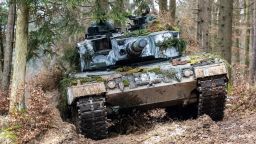
After weeks of pressure from allies, Germany and the United States have promised Ukraine dozens of modern tanks to help push back Russian forces, opening the way for Canada, Poland, Finland, Norway and others to make their own pledges.
Ukraine's President Volodymyr Zelensky thanked allies for their support but renewed calls for tougher sanctions on Moscow and made clear his country needed more weapons to repel the invaders in the twelfth month of the war.
Not for the first time in the war in Ukraine, President Joe Biden took decisive action that closed fissures in the alliance. He announced Wednesday he would ship 31 advanced US tanks to Kyiv’s military in a move that prompted a reluctant Germany to drop its resistance to sending its own tanks and could unlock similar moves all over Europe.
This represented a significant symbolic, political and military win for Ukraine. It hopes what it calls its new “iron fist” will punch through entrenched Russian lines in the east, could fuel an advance on Russia’s land bridge to annexed Crimea in the south and will stave off a feared Russian spring offensive.
It took Biden’s statesmanship to end the most public and damaging Western rift of the war so far. The US had previously said its Abrams tanks were too complex and too high maintenance for the Ukraine war and didn’t suit the terrain. But Biden’s change of heart, which gives Germany cover, underscores Washington’s view that Western unity against Putin is critical to saving Ukraine.
Indeed, Putin’s major goal off the battlefield is to forge splits between the Western allies and to disrupt or end the flow of weapons on which Ukraine’s survival as an independent nation depends.
His failure, despite fierce Russian public threats designed to bully European nations into balking at tank transfers, also comes after a mild winter robbed Russia of another prong of its strategy – starving Europeans of gas imports during freezing weather in hopes they’d pressure their own leaders to step back from supporting Ukraine.
“Putin expected Europe and the United States to weaken our resolve,” Biden said at the White House on Wednesday. “He expected our support for Ukraine to crumble with time. He was wrong … and he was wrong from the beginning and he continues to be wrong. We are united.”
An extraordinary strategic shift has taken place
As the first anniversary of the unprovoked Russian invasion approaches, Biden and the West are in an extraordinary position that few strategists would have thought possible a year ago.
— NATO is stronger and more unified than it has been for years. And that is a strategic disaster for Russia. The sense of drift in the alliance early in the 21st century has been driven away by a reminder of the bloc’s founding purpose: a common defense against Moscow’s aggression. Putin’s behavior will ensure that that alliance-nurturing lesson will endure for decades.
— Biden has pinned his legacy on a major land war in Europe in which the United States has engaged in an effective proxy battle with nuclear rival Russia. This fight – which is, in a way, the last battle of the Cold War – is a test of will between an American president and a Kremlin strongman deeply influenced by the US-Soviet standoff. Biden is leading the most significant foreign policy venture at least since the invasion of Iraq in 2003. Its success is critical for America’s credibility as well as his own. The magnitude of the mission is likely to overshadow much of the rest of his presidency – including the current investigation into misplaced classified documents – in world history.
— Biden has restored the US as a strong global leader, reviving its critical transatlantic alliance and steering allies behind the effort with successful and intense diplomacy. And so far, the president’s balancing act – between funneling ever more powerful weaponry to Ukraine and avoiding an escalation with Putin that could lead to a clash with the West or even to Moscow’s use of a smaller scale tactical nuclear weapon – is holding. A dawning second year of war in Ukraine and deepening NATO involvement will test that equation like never before.
— The most remarkable aspect of the evolving relationship between the West and Ukraine is that one of Putin’s presumed motivations for the war was to forestall the possibility that the former Soviet state could join NATO, which would be an even greater humiliation for Moscow than the accession of nations once in Warsaw Pact territory like Poland, Romania and Slovakia. But now, Ukraine’s war effort is being armed and bankrolled by the West, almost as if it is a de-facto NATO state with access to some of the alliance’s most sophisticated weapons systems.
The West’s rationale for that support is also evolving. Once the main goal was to allow a defenseless nation to repel an unprovoked invasion in order for its people to have freedom to choose their political system and sovereignty. Now, the alliance’s leaders seem to see Ukraine as a vital strategic bulwark.
“If President Putin wins, it is a tragedy for Ukrainians, it also dangerous for us,” NATO Secretary General Jens Stoltenberg told CNN’s Kate Bolduan Wednesday, arguing that an authoritarian nation could not be allowed to exert its will and to profit by threats. “It is in our security interest to support the Ukrainians,” he said.
What’s next?
Just because he keeps failing, Putin is unlikely to stop trying to splinter the Western alliance. Hostility toward the US and its allies and a quest for vengeance has been the foundation of his more than two decades in power. And throttling the supply of weapons to Ukraine and fanning Western fatigue with the war remain crucial to his hopes of grinding out victory or avoiding a decisive defeat.
Moscow reacted furiously to the decision on the tanks, calling it extremely dangerous and adding that it took an already bloody conflict to a new level.
Biden, still seeking to avoid any escalation that could lead to a direct clash between NATO and Russian forces, stressed that the new tanks posed no offensive threat to Russia – if only Putin would withdraw his troops from Ukraine. Critics of the war and the massive flow of western arms will become increasingly worried that the West may end up simply fueling a bloody stalemate that will result in the senseless slaughter of thousands of Ukrainian and Russia troops and Ukrainian civilians. Since Moscow and Kyiv both seem to believe they can still win the war, there’s barely any opening for a diplomatic push for a ceasefire or peace.
Western military strategists are, however, warning that Moscow, after an already bloody onslaught, is readying a new offensive for the spring.
“It is dangerous to underestimate Russia,” Stoltenberg said in a speech in Oslo on Wednesday, pointing out that Moscow had mobilized an extra 200,000 troops and was willing to take great risks and endure staggering losses.
Ukraine, as always, will ask for more
Ukraine will now be under pressure to show it can use these new tanks in properly planned combined military operations that maximize their advantages but minimize their weaknesses to make major battlefield gains. While the German tanks, known as the Leopard 2, could arrive within weeks, John Kirby, the National Security Council’s coordinator for strategic communications, told CNN it would be “many months” before the Abrams machines, which still need to be procured from US manufacturers, arrive.
Still, the diplomatic and military chain of consequences unlocked by Biden’s willingness to send the tanks sent an important message to Moscow.
“They are more important as a symbol of US and European commitment,” retired Gen. Wesley Clark, the former NATO Supreme Allied Commander Europe, told CNN’s Wolf Blitzer.
Ukraine had asked for at least 300 tanks. While it remains unclear how many it will receive in the new allied shipments, the total could be around 100. No doubt it hopes that once turned on, the spigot of new armaments will continue flowing. That’s what has consistently happened in the war.
At the time of the invasion last February, the US and its allies were wary of even supplying basic weaponry. But as the brutal war unfolded, and Ukraine inspired the world with its resistance, barriers to more kinetic help fell away. Kyiv is now getting arms, ammunition, drones, Javelin anti-tank missiles, armored vehicles, Patriot anti-missile missiles and now some of the most sophisticated tanks in the US and allied militaries.
When he was in Washington just before Christmas, Ukrainian President Volodymyr Zelensky warned his country’s needs were so great he would never stop asking for more weapons.
So far, the provision of fighter jets – his government’s most cherished request – has been a red line Biden has been unwilling to cross. It is also one that previously caused splits in the alliance.
But the pattern of this war is that what Ukraine asks for, it eventually gets, even if the scale of its requests for specific equipment is not always met.


:format(webp)/cloudfront-us-east-1.images.arcpublishing.com/tgam/P4FUIHMHH5AEXP7TBMNSWBDRN4.JPG)